
In the previous article on this issue, the discussion was around capital and talent. In this issue of the second installment series, the focus would be on operations & management with the market
Market
An overarching problem for startups as a whole, and the economy in general, is the significant drop in demand—and thus revenues.
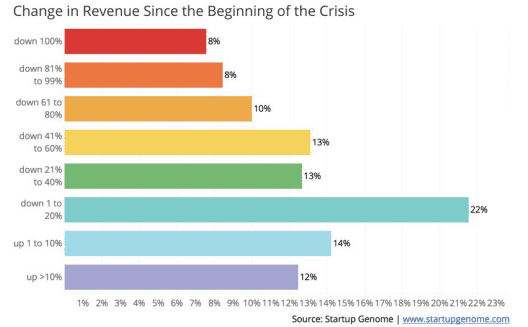
Since the beginning of the crisis, 74% of startups have seen their revenues decline.
The most common type of change in revenue is a relatively modest decline—one out of every four startups saw their revenue decline by less than 20 percent.
However, a sizable share of companies were very heavily hit: 16% of startups have seen their revenue drop by more than 80%.
A major reason for the drops in revenue comes from the effect of the crisis on the industries these startups serve.
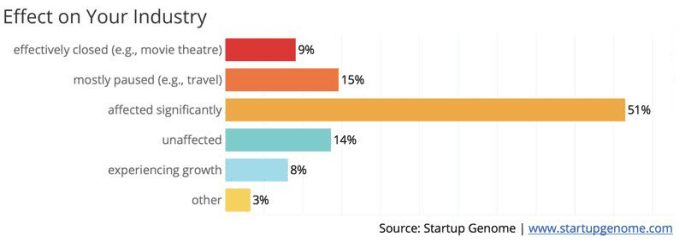
Three out of every four startups work in industries severely affected by the COVID-19 crisis.
At the same time, a small minority of companies is actually experiencing growth. Every crisis creates opportunities. For instance, over half of Fortune 500 companies started during a contraction, and over 50 unicorns were created in the Great Recession alone, as Startup Genome data shows.
The COVID-19 crisis is no exception. 12% of startups have seen their revenue increase by 10 percent or more since the beginning of the crisis, and one out of every 10 startups are in industries actually experiencing growth.
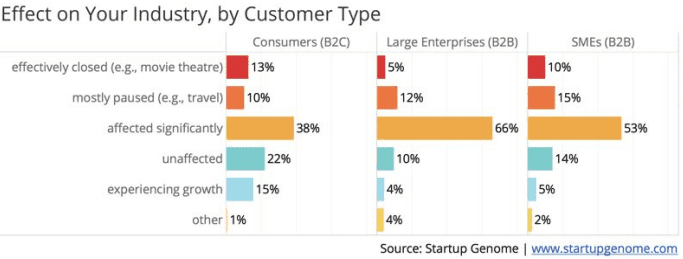
The hurt and growth are not evenly distributed. B2C startups are about three times more likely to be in industries experiencing growth when compared to B2B startups.
This is likely coming from a mix of companies (especially large enterprises) slashing expenses quickly, while consumers are changing their consumption patterns towards spending a higher relative amount of time and money online (which benefits tech companies more than it does ‘traditional’ businesses).
Operations and Management
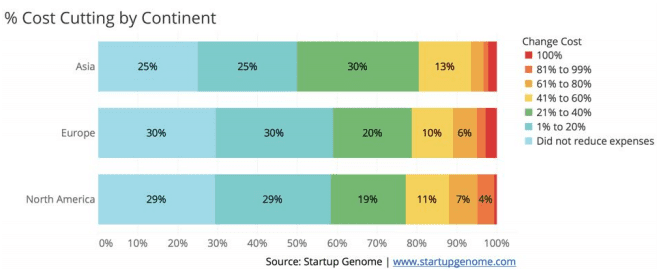
When we look at cost-cutting measures across all categories, over two thirds of startups have reduced their expenses since December 2019, with 42% doing cuts of more than 20%.
Some companies have cut costs very aggressively, with more than one out of every 10 companies reducing costs by over 60%.
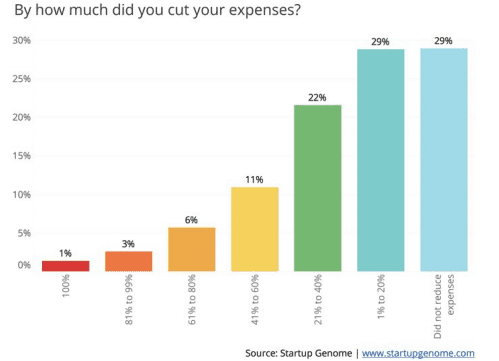
When we look across continents, North American businesses were slightly more aggressive in terms of cost-cutting, with a higher share of them reducing costs by 60% or more.
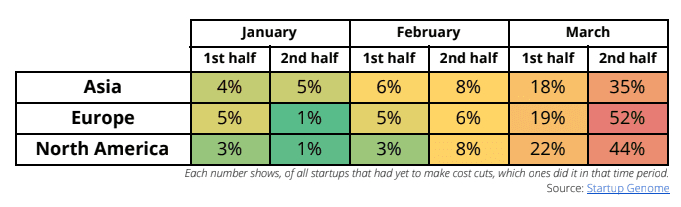
In terms of timing of main cost-cutting decisions, Asian startups started cutting costs a little bit earlier, but not by much.
Nonetheless, despite the squeeze in reducing costs, tech startups are uniquely situated to continue operating even in lockdown scenarios.
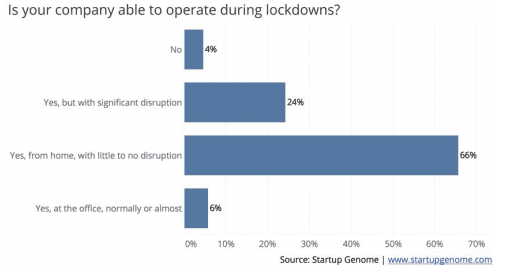
Unlike many traditional businesses, 96% of startups can continue working during lockdowns, even if there is a significant disruption.
Featured Image: genglobal.org
Don’t miss important articles during the week. Subscribe to cfamedia weekly digest for updates.