

For decades, Nigeria’s national examinations have followed the same familiar format: pen, paper, invigilators, and physical scripts moved across long distances.
But quietly, that model isbeginning to change. Nigeria’s examination system is undergoing a transformation. Driven by the Federal Government’s push to reduce malpractice, improve transparency, and modernise examinations, the country is moving steadily toward complete digital testing.
This effort aligns with a national target to achieve one hundred percent computer based testing for public examinations by 2027.
While objective questions made the transition earlier, theory examinations remained the most complex piece of the puzzle.
That changed during the WAEC examination for private candidates, officially known as the CB WASSCE, a computer-based examination held from late October to mid-December 2025.
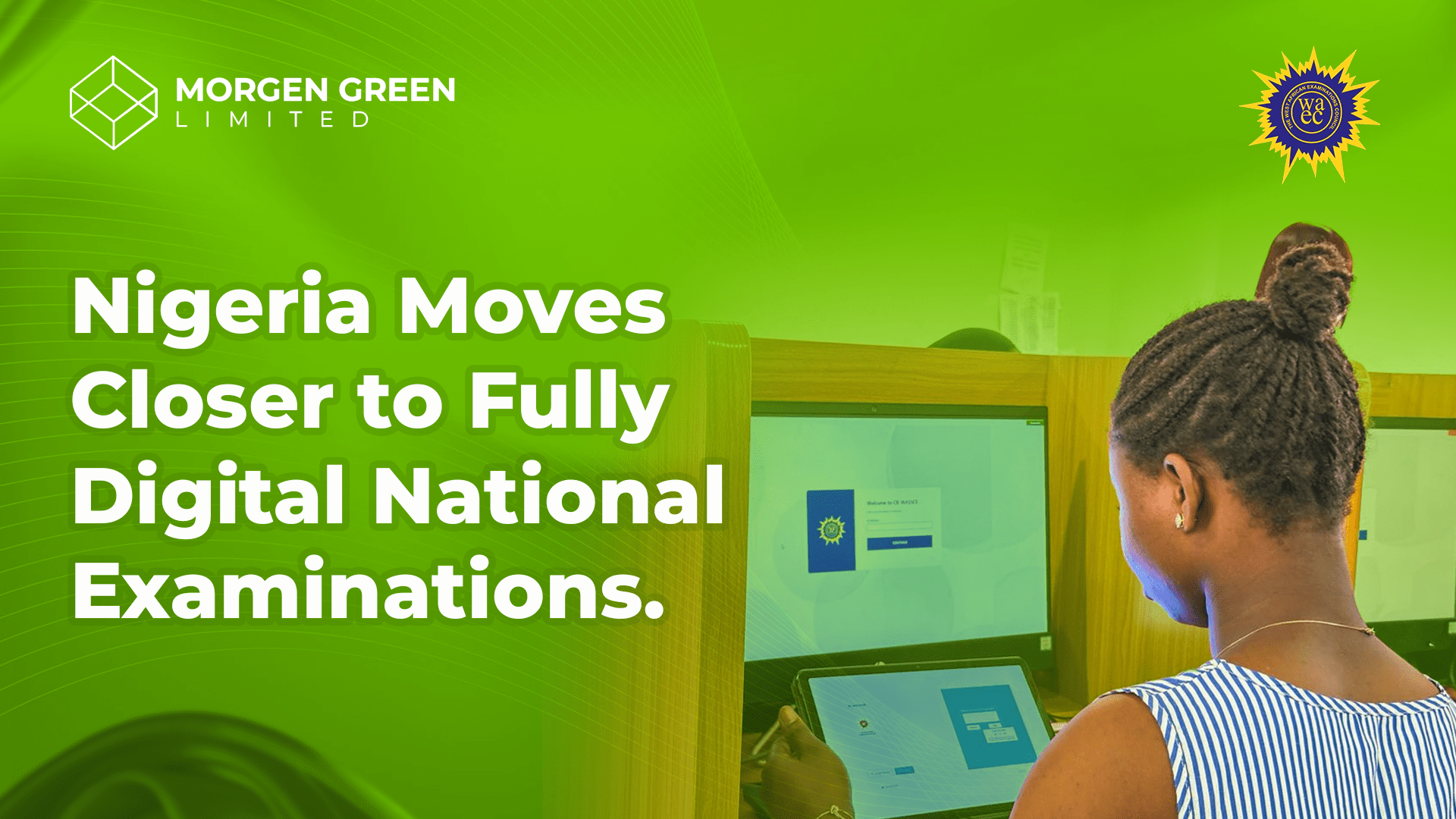
Working in partnership with the West African Examinations Council WAEC, Morgen Green Limited, a Nigerian-based ICT company, deployed a tablet-based examination system that enabled candidates to write long-form theory answers digitally, draw diagrams using stylus input, and complete objective questions within the same secure environment.
All examinations were conducted inside existing CBT centres, under strict supervision, and in full alignment with WAEC’s national examination processes.
This was not a laboratory test or a limited demonstration. These were live national examinations taken by real candidates under standard WAEC conditions.
For many students, this was their first experience writing a full theory exam on a tablet. Initial reactions ranged from curiosity to skepticism.
Some candidates worried about making mistakes, losing answers, or navigating unfamiliar interfaces during a high-pressure exam.
To address this, the examination teams focused heavily on orientation and reassurance. Candidates were guided through the system, allowed to familiarize themselves with the interface, and supported in building confidence before the exams began.
By the end of the cycle, students weren’t just completing the exams. They were engaging with them comfortably. Many reported that writing felt clearer, navigation was easier, and the processreduced the stress often associated with paper scripts. Post-exam interviews captured students describing the experience as “surprisingly easy” and “more organized” than expected.
The significance of the shift was further underscored when the Honourable Minister of Education, Dr. Tunji Alausa visited CBT centres to observe the digital examinations in progress.
The visit highlighted government interest in scaling digital examinations as part of broader education reform.
Beyond student experience, the implications are substantial. Digital theory examinations reduce the risks associated with physical scripts, strengthen monitoring and accountability, and support more efficient examination management at scale.
As WAEC continues its digital transition and the Federal Government advances toward its 2027 target, partnerships between examination bodies and local technology providers are becoming central to the future of assessment in Nigeria.
With national policy, institutional readiness, and proven execution now converging, Nigeria’s journey toward fully digital examinations is no longer aspirational.
It is underway, and it is setting a precedent for how large-scale education systems across Africa can evolve responsibly through technology.
Don’t miss important articles during the week. Subscribe to techbuild weekly digest for updates