


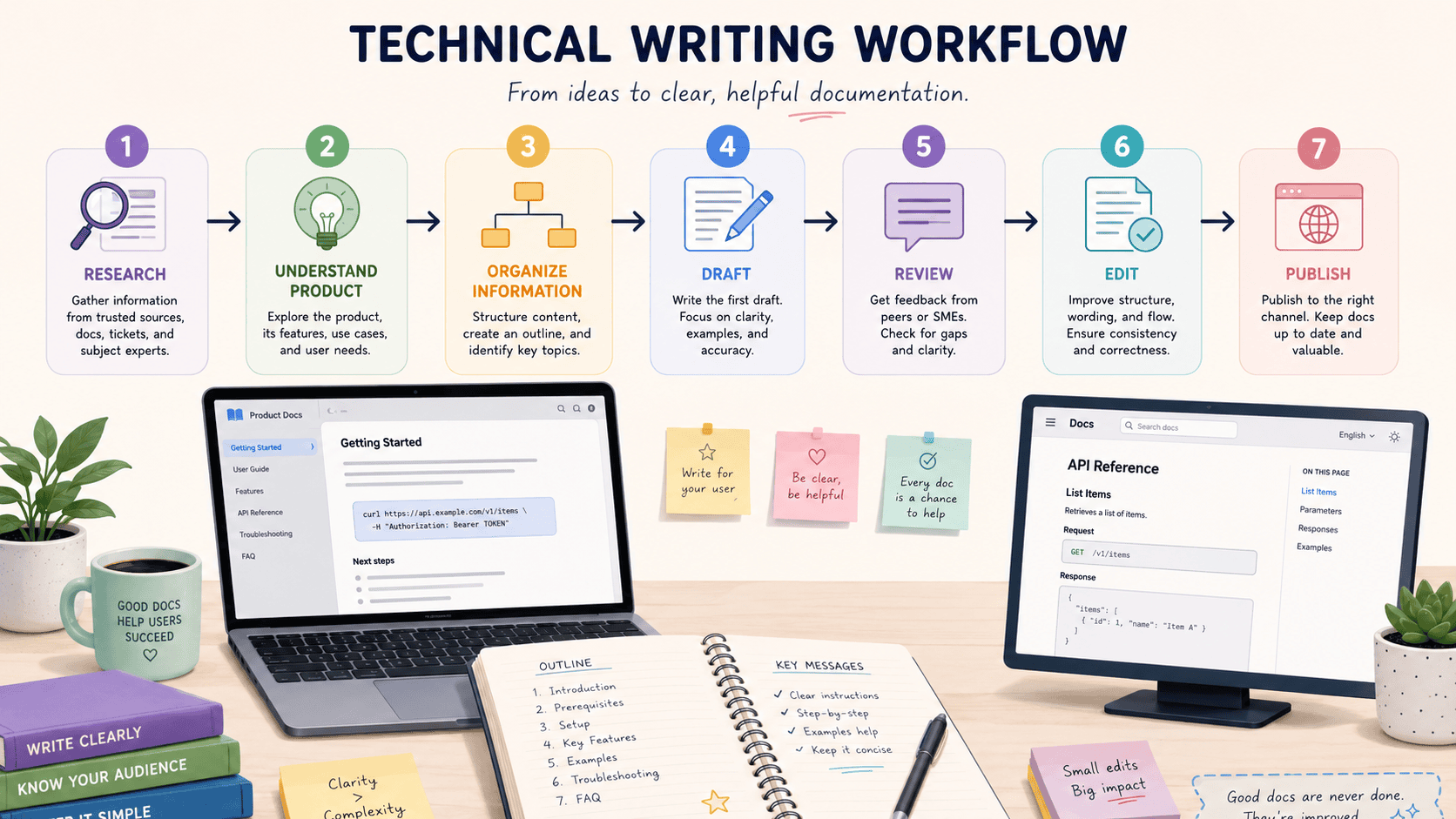
Learning how to become a technical writer can open the door to a career that combines technology, research, communication and problem-solving.
Technical writers help people understand complicated products, systems and processes. They create user guides, software documentation, help-centre articles, tutorials, API documentation, installation instructions and internal company manuals.
You do not need to be a software engineer before becoming a technical writer. However, you must be willing to learn how technology works and explain it in language that ordinary users can understand.
What Does a Technical Writer Do?
A technical writer turns complex information into clear and useful content.
For example, a software developer may build a payment application, but users still need instructions explaining how to create an account, reset a password, make a transfer or resolve a failed transaction.
Technical writers may produce:
- Product documentation.
- User manuals.
- Frequently asked questions.
- Software tutorials.
- API documentation.
- Troubleshooting guides.
- Knowledge-base articles.
- Training materials.
- Process documentation.
- Release notes.
The job is not simply about writing good English. A technical writer must understand the user’s problem, study the product and present the correct information in a logical order.
1. Develop Strong Writing Skills
Technical writing should be clear, direct and easy to follow.
Avoid unnecessary jargon, long introductions and complicated sentences. The goal is not to impress readers with difficult words. The goal is to help them complete a task successfully.
Compare these two instructions:
The user is required to initiate the authentication-reset procedure through the appropriate interface.
A clearer version is:
Select Forgot password on the login page and follow the instructions sent to your email.
Practise breaking long explanations into steps, headings, examples and short paragraphs. Learn how to edit your own work and remove information that does not help the reader.
2. Learn the Fundamentals of Technology
You do not need to know everything about technology. Start with the area in which you want to specialise.
A writer interested in software documentation should understand basic concepts such as:
- Websites and applications.
- Front-end and back-end development.
- Databases.
- Application programming interfaces.
- Cloud computing.
- Cybersecurity.
- Software testing.
- Version control.
You should be able to explore a product, ask informed questions and understand explanations given by developers or engineers.
Free courses, product documentation, technology blogs and practical projects can help you develop this knowledge.
3. Learn How to Research a Product
Technical writers rarely receive every answer in a perfectly organised document.
You may need to test the product, interview developers, read existing documentation, examine support questions and speak with customer-service teams.
Before writing, find out:
- Who will use the document?
- What does the reader want to achieve?
- What knowledge does the reader already have?
- Which steps must the reader complete?
- What could go wrong?
- Where can the reader get additional help?
Good technical writing begins with good research. Writing before understanding the product usually leads to inaccurate or confusing documentation.
4. Understand Documentation Structure
Technical documents should be easy to scan.
A simple tutorial may contain:
- A clear title.
- A short explanation of the task.
- Requirements or prerequisites.
- Step-by-step instructions.
- Screenshots or examples.
- Common problems.
- The expected result.
- Related resources.
Each document should focus on a specific user need. Instead of creating one extremely long guide, divide the information into smaller articles that readers can find quickly.
5. Learn Common Technical-Writing Tools
Technical writers use different tools depending on the organisation.
Basic tools may include:
- Google Docs or Microsoft Word for drafting.
- Markdown for lightweight documentation.
- Git and GitHub for managing documentation alongside software code.
- Content-management systems for publishing help articles.
- Diagramming tools for explaining processes.
- Screenshot and screen-recording tools.
- Grammar and readability tools.
- Documentation platforms for organising product guides.
You do not need to master every tool before applying for a role. Begin with word-processing software, Markdown and basic GitHub usage.
6. Build a Technical-Writing Portfolio
Employers usually want proof that you can explain technology clearly.
You can build a portfolio without waiting for your first job. Choose familiar applications or open-source products and create sample documentation.
Your portfolio may include:
- A beginner’s guide to using a mobile application.
- A password-reset tutorial.
- A troubleshooting article.
- A software-installation guide.
- An explanation of a technical concept.
- API documentation for a simple project.
- A rewritten version of confusing product instructions.
Each sample should show that you understand the reader, organise information properly and provide accurate steps.
Publish your work on a personal website, GitHub, a writing platform or a well-organised online folder.
7. Contribute to Open-Source Projects
Open-source projects often need help improving their documentation.
You can correct unclear instructions, update installation guides, add examples or create tutorials. This gives you practical experience working with developers and documentation workflows.
Before contributing, read the project’s guidelines and study the existing documentation. Begin with a small improvement rather than attempting to rewrite the entire project.
Open-source contributions can strengthen your portfolio because they show that your work has been reviewed and used in a real project.
8. Learn Basic User Experience Principles
Technical documentation is part of the user experience.
A guide may be accurate but still fail if users cannot find it or understand what to do next.
Think about:
- The reader’s level of knowledge.
- The order in which information appears.
- The words used in the product interface.
- Accessibility for different users.
- Mobile readability.
- Search-friendly headings.
- Clear navigation between related articles.
A good technical writer does not only ask, “Is this sentence correct?” The writer also asks, “Can the user complete the task?”
9. Work With Subject-Matter Experts
Technical writers regularly collaborate with software developers, product managers, designers, cybersecurity professionals and support teams.
Ask specific questions. Instead of saying, “Please explain the feature,” ask:
- What problem does the feature solve?
- Who can use it?
- Are there any requirements?
- What happens when the process fails?
- Has the interface changed?
- Are there security or privacy warnings?
- How can I verify that these steps are correct?
Respect the expert’s time by researching first and organising your questions.
10. Start Applying for Opportunities
Search for roles with titles such as:
- Technical writer.
- Documentation writer.
- Content designer.
- Knowledge-base writer.
- Developer documentation writer.
- Product documentation specialist.
- API writer.
- Technical content writer.
Startups may not advertise a dedicated technical-writing position. They may need someone to create onboarding guides, internal processes, product tutorials or customer-support content.
Freelancing can also provide experience. Begin with manageable projects and define the deliverables, revision process, deadline and payment terms clearly.
Skills That Make a Technical Writer Valuable
Successful technical writers usually combine several abilities:
- Clear writing and editing.
- Curiosity about technology.
- Attention to detail.
- Research and interviewing.
- Logical organisation.
- Product testing.
- Basic visual communication.
- Collaboration.
- Empathy for users.
- Willingness to keep learning.
Knowledge of a specific industry can also make you more competitive. A writer who understands banking, healthcare, cybersecurity, telecommunications or government technology may be able to explain specialised products more accurately.
Common Mistakes to Avoid
Do not copy technical explanations without confirming that they are correct. Avoid writing for experts when the intended reader is a beginner. Do not assume that every user has the same device, internet connection or level of knowledge.
You should also avoid creating documentation and never updating it. Product interfaces, policies and features change. Documentation must be reviewed regularly so users do not follow outdated steps.
Final Thoughts
Becoming a technical writer requires more than good grammar. It requires the ability to learn a system, identify what users need and communicate the correct information clearly.
Start by improving your writing, learning basic technology concepts and creating practical documentation samples. Build a portfolio, contribute to real projects and develop the confidence to ask technical questions.
The best technical writers are not necessarily the people who know the most complicated technology. They are the people who can understand complexity and make it useful to others.
Don’t miss important articles during the week. Subscribe to Techbuild weekly digest for updates