
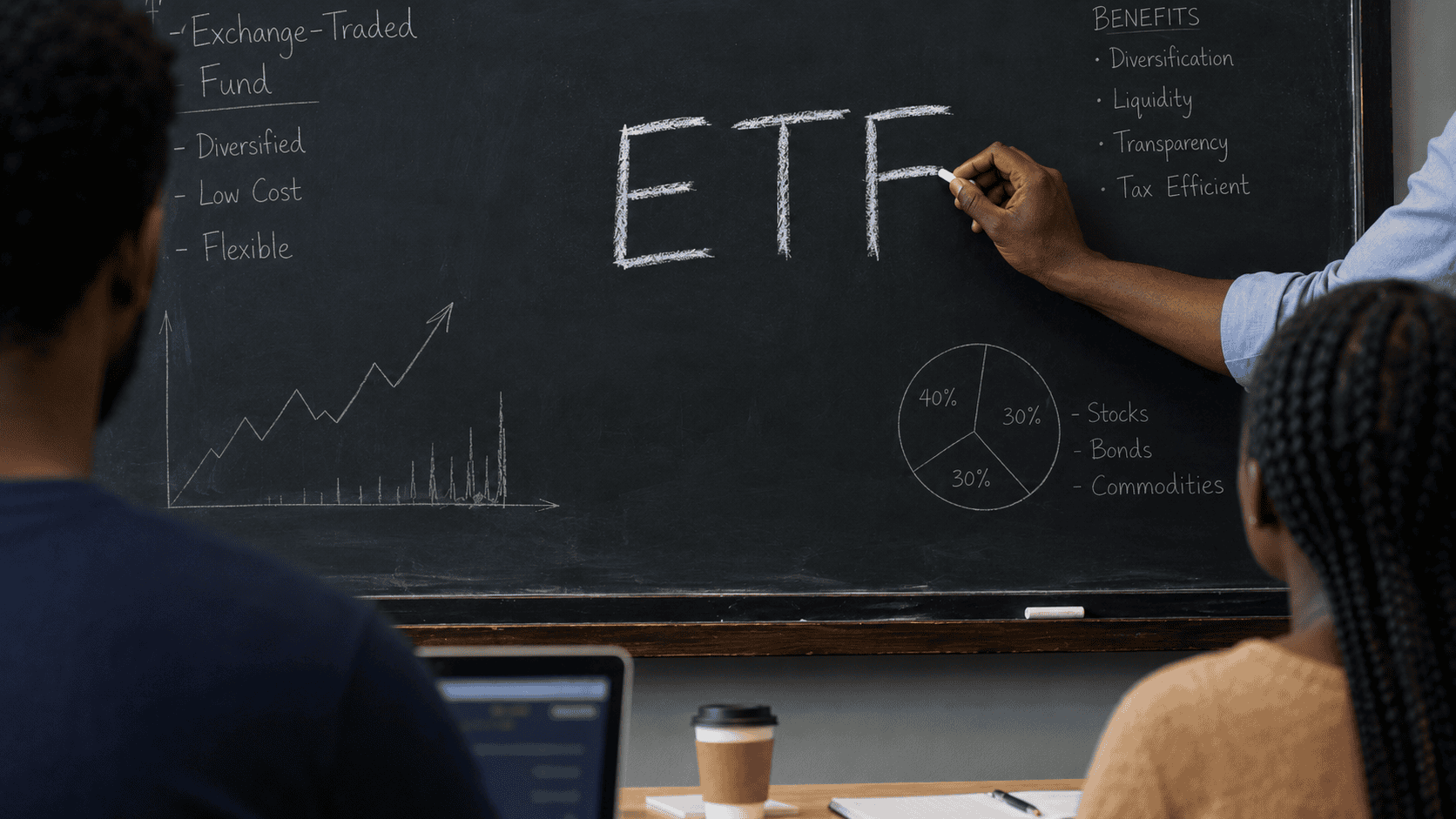
Imagine you want to invest in 100 companies, but buying shares in every company individually would be expensive and complicated. An Exchange-Traded Fund, or ETF, can bundle those investments into one basket.
When you buy a share of that ETF, you are buying a small interest in the basket rather than selecting every investment yourself.
An ETF pools money from investors and holds assets such as shares, bonds or other investments. Each ETF share represents part ownership of that portfolio. Unlike a traditional mutual fund, ETF shares trade on a stock exchange throughout the trading day, so their market price can rise and fall while the market is open.
This combination of diversification, accessibility and trading flexibility has made ETFs an important part of modern investing.
How ETFs Work
Suppose an ETF is designed to track the S&P 500, an index representing many of the largest publicly traded companies in the United States.
Instead of choosing Apple, Microsoft, banks, healthcare companies and hundreds of other stocks separately, the ETF attempts to hold the companies needed to follow that index.
The Vanguard S&P 500 ETF, VOO, is one example. It seeks to track the S&P 500 and had an expense ratio of 0.03% as of April 2026.
Other well-known examples include:
SPDR S&P 500 ETF Trust, SPY: another fund following the S&P 500.
Invesco QQQ: focuses on companies represented in the Nasdaq-100.
Vanguard Total Stock Market ETF, VTI: provides much broader exposure to the U.S. equity market; Vanguard listed its expense ratio at 0.03% in 2026.
Vanguard FTSE Emerging Markets ETF, VWO: invests across emerging markets including countries such as China, Brazil, Taiwan and South Africa.
iShares Core MSCI World UCITS ETF: provides exposure to companies across developed markets; one major share class held more than 1,200 securities in July 2026.
ETFs can also focus on bonds, dividends, property companies, gold, technology, artificial intelligence, clean energy or particular regions.
The iShares Global Clean Energy ETF, for example, tracks companies involved in the global clean-energy sector.
Some markets also offer products providing cryptocurrency exposure. These should not be confused with broad stock-market ETFs: concentrated, commodity, cryptocurrency, leveraged and inverse products can carry substantially different risks.
ETF, Stock, Mutual Fund or Index Fund?
An individual stock represents ownership in one company. If you buy one company and that company performs badly, your investment is heavily exposed to that result. An ETF containing hundreds of companies spreads that risk across many businesses. Diversification cannot prevent losses, but it reduces dependence on one company.
A mutual fund is also a pooled investment. The major difference is trading. Traditional mutual-fund transactions normally occur based on the fund’s calculated value, while ETFs trade on an exchange during market hours at prices determined by buyers and sellers.
An index fund is not automatically a different product from an ETF. “Index fund” describes the investment strategy. It attempts to follow an index rather than have a manager constantly choose investments in an effort to beat the market. An index fund can therefore be structured as either an ETF or a mutual fund.
ETFs can also be actively managed, meaning professional managers decide what to buy and sell instead of simply tracking an index. The JSE, for example, has expanded its actively managed ETF market during 2026.
Fixed-income products and money-market funds serve different purposes. They usually focus more heavily on capital preservation or income and may fluctuate less than equity ETFs, but expected growth may also be lower.
A savings account is different again: it is a bank deposit rather than an investment fund.
Why Investors Use ETFs
One major advantage is diversification. A single broad-market ETF can expose an investor to hundreds or even thousands of securities.
Another is cost. Many index ETFs use passive management, reducing the research and trading required compared with some actively managed funds. But low cost should never be assumed: ETFs have different fees, and regulators warn that even small differences in expenses can significantly affect returns over time.
The most visible fee is the expense ratio. An expense ratio of 0.20%, for example, means the fund’s annual operating expenses equal approximately $2 for every $1,000 invested. The fee is normally deducted within the fund rather than sent to the investor as a separate bill.
Investors may also face brokerage charges, foreign-exchange costs and the bid-ask spread; the gap between what buyers are offering and sellers are asking for an ETF share. Less frequently traded ETFs can have wider spreads.
ETFs also have a Net Asset Value, or NAV, representing the value of the portfolio’s assets minus liabilities divided by its shares. Because ETFs trade in the market, the trading price can sometimes be slightly above or below NAV.
Another concept is tracking error. An ETF attempting to follow an index may not reproduce its performance exactly because of fees, transaction costs, portfolio construction and other factors.
ETFs are not risk-free. A stock-market ETF can fall sharply when markets decline. A technology ETF can become concentrated in one sector. Bond ETFs face interest-rate and credit risks. International ETFs introduce political and currency risks.
Dollar-cost averaging—investing a fixed amount regularly instead of trying to predict the perfect market entry point—can help investors follow a consistent long-term strategy, but it does not guarantee profits.
The same applies to compound growth: reinvesting returns over many years can increase long-term wealth, but only when investments actually generate positive returns over the period.
ETFs in Africa
African investors do not necessarily need an overseas brokerage account to encounter ETFs.
The Nigerian Exchange already lists several exchange-traded products. Its April 2026 official ETF list included NewGold ETF, Vetiva Griffin 30 ETF, Stanbic IBTC ETF 30, Vetiva Banking ETF, Vetiva Consumer Goods ETF, a sovereign bond ETF and other products.
This means a Nigerian investor can use ETFs for exposure ranging from Nigerian equities and sectors to bonds and gold without individually purchasing every underlying asset.
South Africa has the continent’s most developed ETF ecosystem. The Johannesburg Stock Exchange lists ETFs and ETNs covering local shares, bonds and international assets, and investors can purchase them through authorised brokers and investment platforms.
In 2026, the JSE added products providing exposure to Japan, Europe and additional actively managed domestic and global strategies.
Kenyan investors also have local ETF access. The NewGold ETF has traded on the Nairobi Securities Exchange since 2017 and provides exposure to physical gold through an exchange-listed instrument.
Egypt has the EGX30 Index ETF, which tracks the country’s flagship EGX30 equity benchmark.
Access differs significantly across African countries, however. Some markets have several ETFs, while others have little or no local ETF selection.
Investors in some countries can also access international markets through regulated brokers, local firms offering international trading or cross-border investment platforms.
The key word is regulated. Before transferring money, an investor should check whether the brokerage or investment platform is authorised by the relevant regulator and understand how assets are held.
International investing also creates currency risk. An ETF may rise in dollars while changes in the naira, rand, shilling, cedi or another home currency increase or reduce the investor’s effective return.
Taxes can also depend on the investor’s country of residence, the ETF’s domicile, dividend withholding rules and whether the investment produces income or capital gains. There is no single tax rule for “African ETF investors,” so investors should check the applicable rules in their jurisdiction.
How Beginners Can Evaluate an ETF
Do not start by asking, “Which ETF made the most money last year?” Start by asking what the ETF actually owns.
A beginner can check five things: the fund’s objective, holdings, expense ratio, risk level and the index or strategy it follows.
A broad global stock ETF and an artificial-intelligence ETF may both be ETFs, but they are very different investments. The first may spread money across industries and countries, while the second concentrates exposure around one theme.
Next, consider liquidity and tracking quality. Look at how closely the fund follows its benchmark and whether its shares trade actively.
Finally, think about asset allocation: how much of an overall portfolio belongs in stocks, bonds, cash or other assets given the investor’s goals and ability to tolerate losses.
Rebalancing periodically means restoring that chosen mix when market movements cause one part of the portfolio to become disproportionately large.
ETFs have become useful not because they remove investing risk, but because they can make diversification easier.
For African investors, they can provide a bridge between local capital markets and sectors, companies and economies that would otherwise be difficult to access individually.
But an ETF is only a container. What matters most is what sits inside that container, how much it costs, what risks it carries and whether it fits the purpose for which the money is being invested.
Don’t miss important articles during the week. Subscribe to Techbuild weekly digest for updates