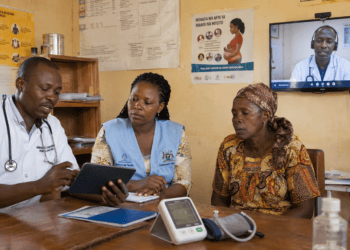


Telemedicine in Africa is making it possible for a patient in a remote community to speak to a doctor hundreds of kilometres away, receive a prescription and arrange follow-up care without travelling to a major hospital.
At its simplest, telemedicine means delivering clinical healthcare remotely using technology. A consultation may happen through a video call, phone call, mobile app, WhatsApp or another secure digital platform.
Telemedicine is slightly different from telehealth, which includes a wider range of remote health services such as medical education, patient monitoring and administrative support. Digital health is broader still, covering electronic health records, mobile health applications, artificial intelligence, wearables, digital pharmacies, health data systems and other technologies used across healthcare.
The World Health Organization says digital health tools can help overcome distance and time barriers while supporting treatment, health-worker education and public-health monitoring.
For Africa, that matters because the problem is not simply having enough hospitals. Specialists, laboratories, medicines and trained health workers are often concentrated in major cities, leaving rural patients travelling long distances for services that could sometimes begin remotely.
Why Telemedicine in Africa Is Growing?
The spread of smartphones, mobile payments, electronic health records and cloud software has created the infrastructure on which virtual healthcare can operate.
Africa had about 416 million mobile internet users in 2024. Yet the connectivity challenge remains substantial. GSMA’s 2026 data shows that around 63% of Africans live within mobile broadband coverage but still do not use mobile internet, largely because of affordability, device costs and digital-skills barriers. This explains why successful African telemedicine cannot rely only on high-definition video.
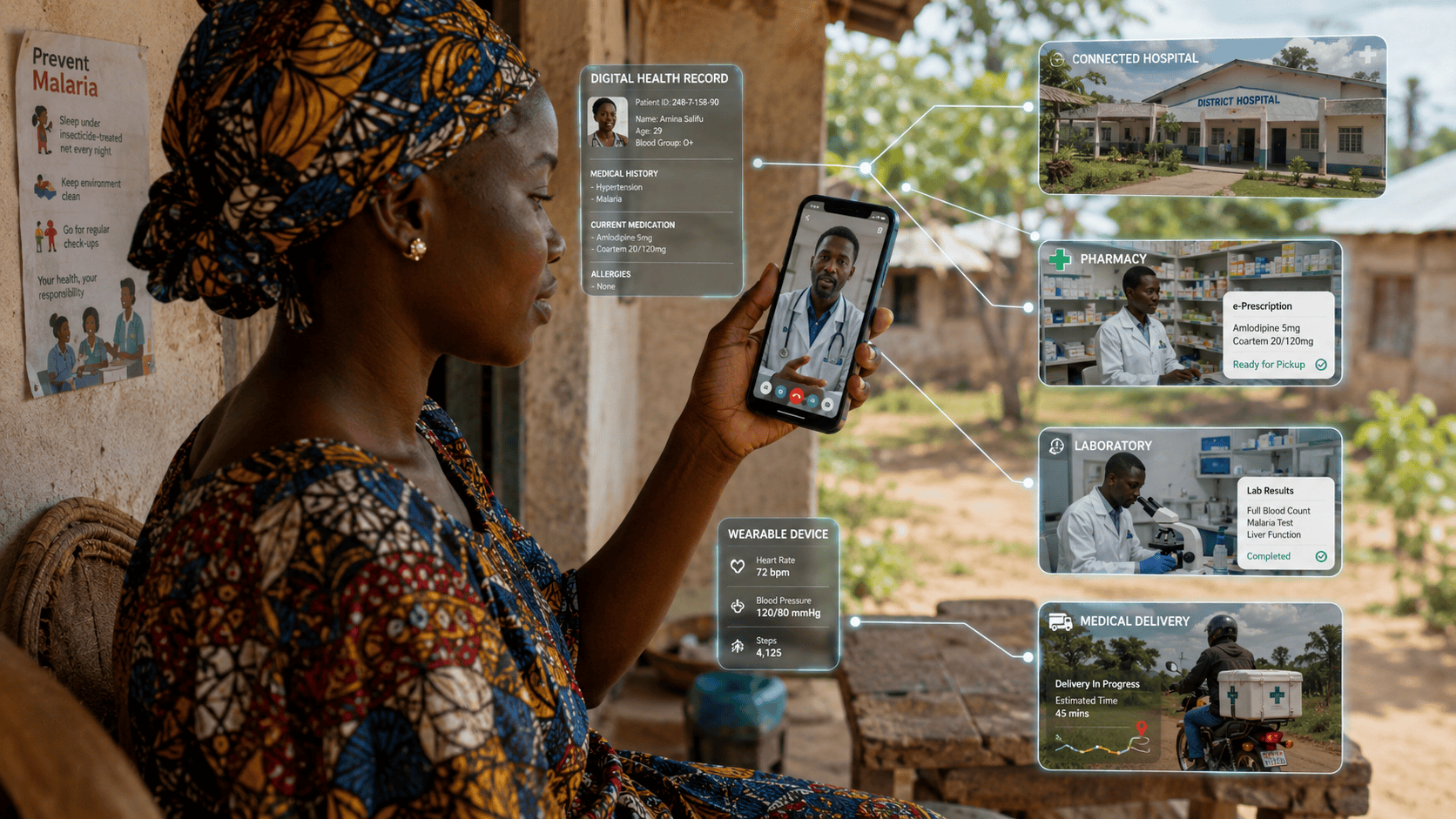
A patient may use an app in Lagos, a telephone call in a smaller town or USSD in an area with weak internet. Uganda’s Rocket Health, for example, offers remote consultations through phone and WhatsApp and allows people without internet access to use USSD or call a toll-free number. Its wider service connects teleconsultation with laboratory sample collection, pharmacy delivery and chronic-care management.
In Nigeria, Reliance Health provides doctor consultations through its mobile platform, including 24/7 remote access, prescriptions and referrals where further care is required.
Helium Health combines telemedicine with electronic medical records and hospital technology. Its HeliumDoc service allows patients to find doctors, book appointments and access video consultations, while HeliumOS gives providers digital patient records. The company says HeliumDoc connects patients with more than 2,000 doctors and has facilitated over 250,000 bookings.
In 2025, Helium Health also deployed HeliumDoc AI in flood-prone areas of Delta and Bayelsa states. The system connects patients to remote clinicians while supporting feature-phone access through USSD, showing how virtual healthcare can also support emergency and disaster response.
Ghana-based mPharma demonstrates how telemedicine can connect with pharmacy networks. Its Mutti platform combines access to medicines and continuing care with services including teleconsultations. mPharma says its broader network has reached more than two million patients across four African countries.
Rwanda was an early adopter. A government partnership with Babyl introduced mobile consultations, digital prescriptions and AI-supported symptom assessment. Babyl reported more than two million registrations during its expansion, making Rwanda an important early example of large-scale digital primary care in Africa.
Egypt’s Vezeeta similarly allows users to search for doctors and arrange remote consultations by specialty, while Morocco-based DabaDoc provides video consultations and connects patients with thousands of healthcare professionals.
These companies follow models seen internationally through platforms such as Teladoc Health and Amwell, but African providers increasingly adapt virtual healthcare to local realities: lower bandwidth, mobile money, fragmented healthcare records and patients who may not own smartphones.
What Technology Makes Telemedicine Possible?
A modern telemedicine visit can begin with a patient describing symptoms in an app. An AI-supported triage system may organise those symptoms and recommend the appropriate type of professional. The patient then speaks to a doctor through video, voice or chat.
The clinician may access an electronic health record containing previous visits, test results, allergies and medications. After the consultation, a digital prescription can be sent to a pharmacy, while laboratory tests can be booked and results returned electronically.
For chronic illnesses such as diabetes or hypertension, connected blood-pressure monitors, glucose meters, smartwatches and other wearables can send measurements to healthcare teams between appointments. This is remote patient monitoring.
A 2024 systematic review in npj Digital Medicine examined 29 studies across 16 countries and found that remote monitoring can support safety, adherence, clinical outcomes and quality of life in certain settings, although benefits vary depending on the condition, technology and care model.
Telemedicine can therefore be particularly useful for chronic-disease follow-up, mental-health consultations, medication reviews, specialist referrals, maternal support, routine primary care and post-hospital monitoring.
Artificial intelligence can add another layer by helping clinicians summarise records, prioritise patients, interpret images or identify risk patterns. Helium Health, for example, now describes AI-assisted analytics and clinical-support capabilities alongside its EHR and telehealth infrastructure.
AI should support, not independently replace clinical judgement. A symptom checker can recommend that someone seek urgent attention, but it cannot perform every examination or diagnostic test.
Similarly, drones are extending what happens after a virtual consultation. Zipline’s medical-delivery model in Rwanda and Ghana has demonstrated how digital ordering can be combined with autonomous logistics to deliver blood, medicines and other medical supplies to difficult-to-reach facilities.
Africa CDC identifies telemedicine, EHRs, mobile health, health-information exchange, precision medicine and digital supply chains among the technologies capable of strengthening African health systems.
Telemedicine Cannot Replace Every Hospital Visit
Telemedicine works best when the clinical problem can be assessed safely without a physical examination or when it supports continuing care between visits.
A doctor cannot remotely stitch a wound, perform surgery or physically examine an abdomen. Some patients with breathing difficulties, severe injuries, pregnancy complications, chest pain or other emergencies require immediate physical care.
Rocket Health explicitly warns that remote diagnosis can be limited by the absence of a physical examination. The strongest healthcare model is therefore hybrid care. A patient may begin online, visit a laboratory locally, receive medication through a nearby pharmacy and attend a hospital when examination or treatment requires physical presence.
Kenya is moving towards this connected approach. Its government has made digital health central to its Universal Health Coverage reforms, including electronic community-health systems and national digital-health infrastructure. By September 2025, 8.8 million households had been registered through its electronic Community Health Information System.
Kenya and Ghana have also identified telemedicine and digital-health innovation as areas for collaboration, while Kenya’s Digital Health Agency is building interoperability and national oversight of digital healthcare systems.
South Africa has telehealth programmes that use simpler technologies as well. The Health Foundation’s Tele-Health initiative allows patients at participating community health centres to request doctor callbacks through USSD, demonstrating that telemedicine does not always require an expensive smartphone application.
The main barriers remain affordability, connectivity, trust and regulation. Healthcare information is among the most sensitive personal data an organisation can collect. Telemedicine platforms therefore need strong encryption, identity controls, secure health records and clear consent processes.
Countries must also address who is allowed to diagnose a patient remotely, whether a doctor licensed in one jurisdiction may treat someone in another, how insurance pays for virtual consultations and what happens when an AI-assisted recommendation contributes to an error.
There is also a risk of creating a new healthcare divide. A wealthy urban patient may have fibre broadband, a smartwatch and private digital insurance while a rural patient lacks a reliable phone connection.
WHO has warned that poorly coordinated digital-health programmes can deepen inequalities rather than solve them. That is why the future of telemedicine in Africa may depend less on building more apps and more on connecting the entire health system.
Patients need interoperable health records. Doctors need reliable clinical information. Pharmacies need digital prescriptions. Laboratories must return results securely. Insurers need workable reimbursement models. Governments need standards that allow systems to communicate without compromising patient privacy.
5G, satellite internet and expanding fibre networks will improve video consultation and remote diagnostics. Wearables will make continuous monitoring more practical. AI will support triage and clinical decision-making, while predictive analytics could identify high-risk patients before emergencies occur.
But the most successful African telemedicine platforms will probably be those that work even when the technology is imperfect—combining apps with SMS, USSD, mobile payments, local pharmacies, community health workers and physical hospitals.
Telemedicine will not replace the doctor’s consulting room. Its greater opportunity is to make sure the consulting room is no longer the only place where healthcare can begin.
Don’t miss important articles during the week. Subscribe to Techbuild weekly digest for updates