


Google’s latest update to Google Chrome signals a deeper shift in how information flows across the web, with implications that stretch beyond browsing into how users discover financial data, research digital assets, and interact with markets.
At the center of the update is an expanded “AI Mode” that collapses the gap between search, analysis, and action.
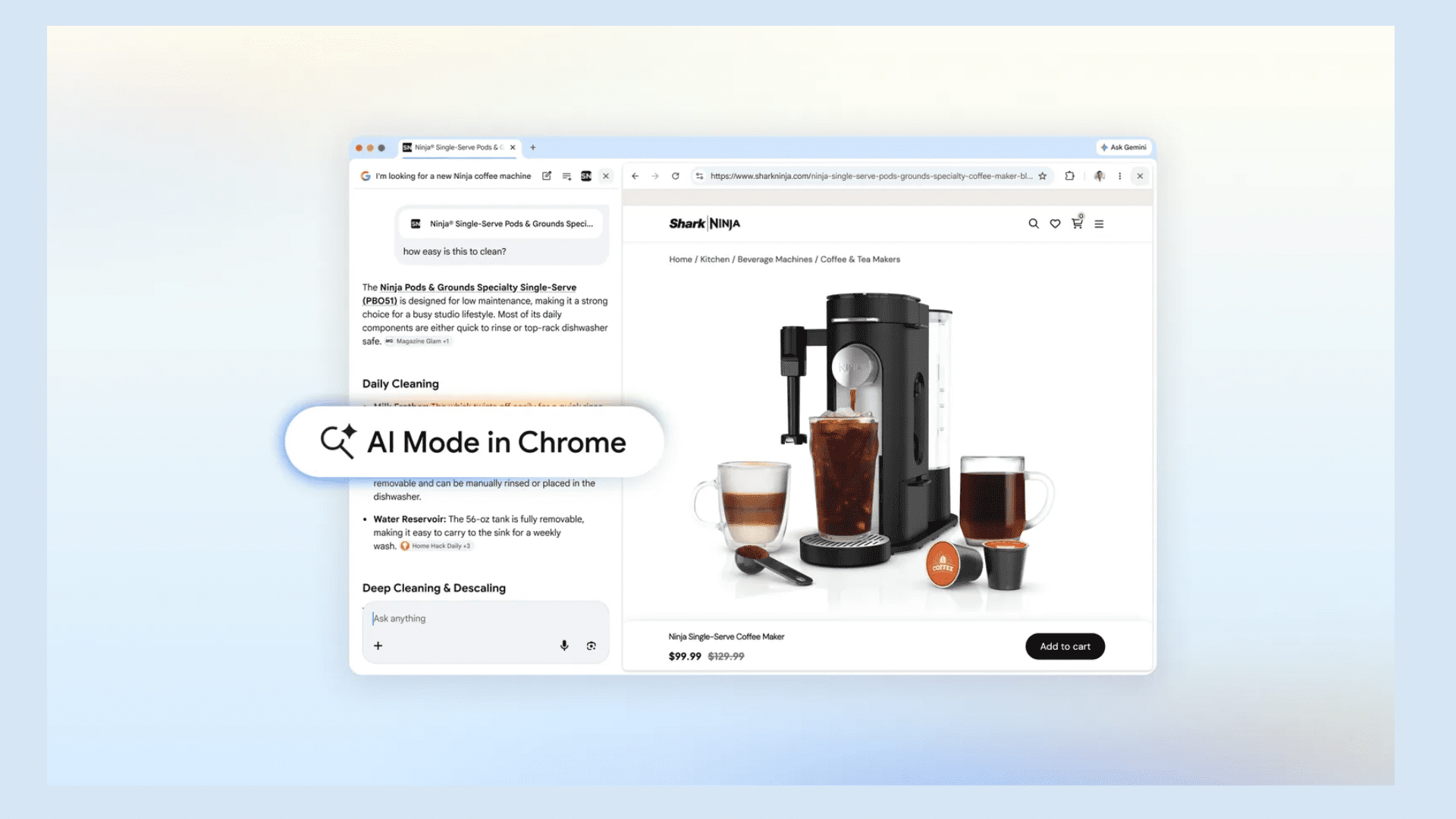
Instead of pushing users across multiple tabs, Chrome now keeps AI responses fixed in a side panel while opening links alongside it.
The result is a continuous workspace where content and interpretation sit next to each other, allowing users to interrogate information in real time without losing context.
This structural change alters the rhythm of online research. For traders tracking token movements or analysts reviewing protocol updates, the browser begins to resemble a terminal rather than a gateway.
A user can open a whitepaper, keep AI Mode active, and extract summaries, comparisons, or clarifications without leaving the page.
That same interface can pull in multiple tabs, PDFs, or images as inputs, turning scattered sources into a single query stream.
Chrome’s AI Mode is also moving closer to the data layer itself. The updated tools can reference open tabs directly, removing the need to paste links or restate context.
In practice, that means a portfolio dashboard, a governance proposal, and a market chart can all feed into one prompt, with the AI stitching together insights across them.
For the digital asset space, the consequences are less about convenience and more about control over attention. Research that once required navigating exchanges, forums, and analytics platforms now happens within a single interface controlled by the browser.
This keeps users inside Google’s environment for longer stretches, reducing the friction of jumping between sources while quietly reshaping how traffic flows across the web.
This development has a major side effect: as AI becomes the main way users understand data, the line between raw information and processed insight starts to disappear.
While the rollout is currently limited, this is not just a standard feature update; it is a shift in how the browser works, moving it from a passive tool into an active partner that filters, combines, and acts on information for the user.
Don’t miss important articles during the week. Subscribe to techbuild weekly digest for updates