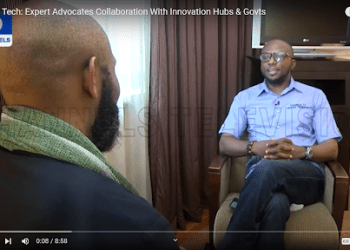



Harriet: Welcome back. You are watching Business Morning, the last edition for this week on Channels Television and we are broadcasting live from Lagos Nigeria. Just before we went on that quick break, our conversation was on information communication technology being a major component in the strategic development of the power sector and we have been having a conversation in the last couple of minutes with two gentlemen, both of them ICT experts, Jude Mgbaka and Fred Agbata. Both of them are still here with me in the studio. Thank you so much gentlemen for staying with me.
Jude and CFA: Thank you.
Harriet: Well, just before we went on that quick break, Fred, you were talking about how the companies should begin to implement core ICT’s strategies. You also mentioned the fact that, that was earlier on, on the conversation about a particular company that’s actually starting to look at smart grid. Why is it that they are not embracing technology to ensure that? This reform that we are beginning to see should actually go faster than what we have right now.
CFA: Well, I think, the risk level actually points out the fact, because they also want to be careful about how much they throw into the system. For the company that I mentioned earlier, the company really has a huge and a deep pocket and they are trying to work out on a smart grid that they can actually control from their office in Lagos to a large extent. There will be very few engineers who will be aware about where it is situated. So, one of the reasons is simply the risk and the cost. So what are the guys are trying to do? They are trying to see how they can compact and manage these, what they have on ground now. They will begin to use them. But unfortunately, they still express issues every now and then. Cable costs, this happens, that happens, gas issues and everything. So, I think they just have to go in, go all out and see that they make the investment that is necessary. One of the things, I think, is the fact that people want to see that they are actually paying for what they are using. So, one way I think they should start from is to reinvent the metering, that was stopped along the way. You know it was there about 3, 4 or 5 years ago. All of a sudden they have stopped it totally. So, I think you find a way, if you have people, who get in a very minimal cost or getting it for free. You should find a way to let people have those things. So, people are staying out of their house, they are moving a card. They are paying for what they are using. But there are smarter meters. What they have now, the card ones, where you just move the card and it works. There are smarter ones. Just log on to the internet and all the lights in your home will be put off.
Harriet: Yes. You know, we have a very annoying habit. A lot of Nigerians have this very annoying habit of leaving their houses and leaving the lights on just like you actually said. Here is the first step. The first step is beginning to understand that we should change our culture. You are leaving your house; you must turn off all the lights in the house, make sure all the electrical appliances that are not in use are actually turned off. That’s the best way for you to begin to conserve your electricity and ensure that you are not overspending. And then, when they get the bill, they say, “I don’t know? Where did I get this bill from?”, forgetting that you have actually left all your electrical appliances on and so it began to eat into the power supply that you will actually pay for. But now, there is this argument that ICT can actually be used to secure transmission lines. How true is this? Is it not going to be a misemployment of sorts?
Jude: Okay. One key thing I think we don’t know about is remote monitoring. So, like I said earlier on if I am in this location and I can’t see all the nodes that connect the network that we are monitoring, right when one goes off, that means the moment vendors or those who want to take advantage of remote connections, touch the cable or do anything that makes the cable change in its behavior. I just know what is going on and then, a quick response can be made. So it’s like essentially you see that, I have a view in the whole infrastructure from a remote location. So you may have people, say, for example you have that kind of view here in Lagos and then you have infrastructure somewhere in all other States. You may have people close by, who you can easily just call out by chance and say, look at what is happening in this area? Would you guys go on and check out what is going on there? When people even know that you are remotely monitoring things, they become careful about trying to take advantage of such remote connections. People behave differently when they know they are being watched. Essentially when it concerns my grid, it goes beyond just having good management of consumption of power. It’s happy to be assured that the whole connections are safe.
Harriet: That’s including your gas pipelines as well. So transmission and gas pipelines?
Jude: Exactly.
Harriet: Now what about in terms of monitoring? How can ICT actually help limit losses of electricity being consumed?
CFA: From what he said, if you install those security nodes along the line, you will be alerted at each point that there is Security Breach. In addition to that, we can begin to think, because we are in a very unique environment, because we need to think about also installing solar power, CC TV cameras on those lines. Yes it may not be perfect, but it will also add to reviewing what is happening. That would enable the new owners of the companies to understand what is going on along their transmission lines where ever they are. So, those are some of the ways that ICT can actually help monitoring…
Jude: To add on the question asked on the monitoring of consumption, because you mentioned the fact that people leave their lights on. This is a behavior that has grown over the years. We use light to know when there is power supply. We leave it on and then we say; oh yeah, there is power now. So, the thing is, if you have a meter like I have in my house for example, it is a little bit smart, because I can tell how I use power over a period of a month. So when we are efficient enough to turn off the power and turn off the freezer when we don’t need it. We find another power supply. So people would be controlled by the structure you put them in. It is structure insistent that made them behave well. So if you put a kind of meter that people can actually see. “Oh, I have 25 units left”. Now, all lights need to go off. They would naturally behave differently. It means they are seeing the benefits of their behavior. The way it has to be in particular, the first thing you ask yourself is, why? Why are you telling me now, all of a sudden, because you are so conscious about whether my light is on or off? So, the consumption can….. because there is a lot of wastage going on. I have been in a debate, where, we were talking about what the government should do about power supply? And then, someone said we should minimize wastage. Then somebody said, “Why should we minimize wastage when we know they’re supplying enough. Let them supply enough.’ So, we need to control this and ensure people can relate the change of behavior to some concern of benefit. Then, we will manage wastage to a reasonable extent.
Harriet: Okay, I was just going to ask, you know these days we have a lot of cloud computing. Everybody does cloud computing, everybody stores their documents in the cloud. Some form of cloud or the other. Now, can cloud computing help to effectively tackle electricity issue? For instance
Jude: Okay, I think cloud computing is interested in this case, because cloud computing companies take power of the computing system into a remote location and then all the power goes there. So, you have different definition for cloud computing. But essentially, infrastructures can be put in place to ensure that there is an improvement on the power systems. Now, let me just go into this, what is going on in places like the US and the likes, is the fact that the smart grid for example, we would be able to or, we are intelligent enough to allow for multiple sources of power input.
Harriet: Okay?
Jude: So for example if you are in my home, I have solar panels. Alright, so, I generate some form of power by myself. If I am traveling I could leave that on and it would feed into the grid and I get paid.
Harriet: Okay, so in other words you are making money for yourself on the side?
Jude: Yes, in fact, it’s already happening. For instance, somebody is generating power at home. So sometimes he turns off all his lights and feed power to the grid. For that to happen, ICT has a major role to play. For example, if I am using a windmill and in some cases the power supply for my wind would be low depending on the difference of wind around my neighborhood at that time. The grid would be smart enough to know whether to switch it on or off. It will calculate the power coming from my source and say, okay, this power is good enough for this kind of things and it will allow it to flow. All this will be managed automatically by the kind of infrastructure that we just talked about. Call it cloud computing or call it infrastructure.
CFA: I think that most people who operate the cloud computing infrastructure have also added other forms of electricity generation or power generation to their infrastructure. So, you have for example, Facebook that has multiple data center all over. It has wind mill, it has all sorts and they are trying to promote green energy. We need to start looking at that as well. So, when you said cloud computing, actually it simply means that somebody somewhere has a data center, where you can go and store your information. Somebody would think cloud computing has something to do with the clouds. Actually it needs electricity. What then happens is that it becomes more efficient to use the electricity. But I think, I also want to make a point that all Nigerians, all the things we can do, I think people need to use the bulbs that are 60 volts because we need to think of changing to energy efficient bulbs. It’s very simple, if you produce, if you generate power and then you waste that power, it is still the same thing. So people must have the habit of conserving power at all times. And like you said, for those people who are good at saving power, create incentives for them. That would help because it gives ICT a human face.
Jude: Then again there should be different charges for peak periods and off peak periods. These are the kind of things which can regulate people’s behavior. If you tell me when it’s 2 o’clock, I will pay this amount per unit and then when it’s 8 o’ clock at night, I will pay that amount per unit.
Harriet: And the only way you can achieve this is if you have smart metering.
Jude: Smart Monitoring.
CFA: There’s need to have off peak and peak periods and it worked for them in that period. With a good smart grid and software, you can actually handle that seamlessly at the back end. You don’t have to switch anything. You don’t have to switch off anything when it’s off peak you go and the bill…
Jude: You know why we are discussing this is essentially because we are trying to make this happen fast and soon enough because essentially the private sector does not have a choice. This is the way to go. It’s not whether it should be done or it should not be done. We are just talking about how soon it should be done, really. You don’t have a choice. This is the way to go because when we are talking about privatization, essentially, it’s going to become possible for new players to come in. And it may not look like that now. Without competition there is no privatization.
Harriet: Of course, that will also improve the value chain.
CFA: But even beyond that, the beauty of getting power right, which I believe this is a very good step in right direction, the fact that our GDP is low, just imagine what will happen if we get the power right. People, small businesses, would change a lot, so I think that this is the best thing that we can do. But it’s also to synthesize those in the industry to understand the importance of using ICT to make things happen quicker.
Harriet: Well Fred and Jude. Thank you so much for coming on the program this morning. It’s been an interesting conversation. Most of messages didn’t come in. I hope that they do come in and I will forward them straight to you. So you can answer them. But thank you for coming on the program this morning.
Jude and CFA: Thank you so much.