


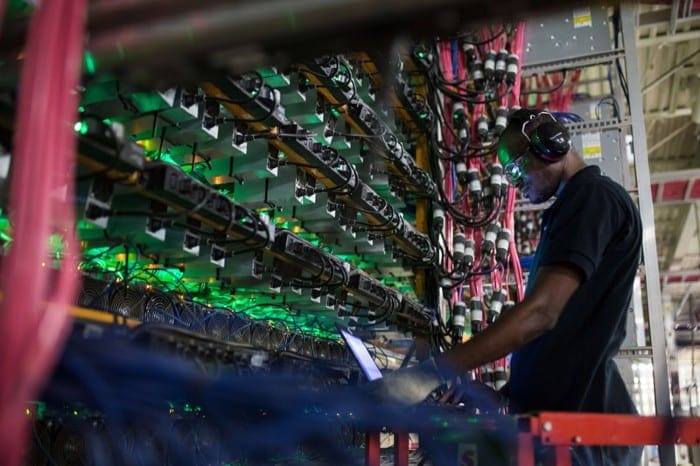
Cryptocurrency mining has been in practice since 2009 when Bitcoin was first launched however, this mining is simply the process by which transactions between crypto users are approved as well as added to the blockchain universal ledger.
In addition, this process of mining also sees the introduction of new coins, bringing them into the existing circulating supply.
It is also one of the fundamental elements that permit cryptocurrencies to work as a peer-to-peer (P2P) decentralized system, without requiring a central authority.
Putting it in simple words, cryptocurrency mining is the procedure that involves keeping blockchain data safe.
Some even say that crypto mining also means getting cryptocurrencies by solving cryptographic equations with the use of computers.
This process requires high computation by computers as well as patience by the miner because it is a slow accumulation of resources like mining for minerals.
Cryptocurrency mining allows anyone can become a miner but it is not for everyone because miners have to sacrifice significant computational power.
The most popular example of a mineable cryptocurrency is Bitcoin, but you must know that not all cryptocurrencies are qualified for mining.
To mine Bitcoin depends on the consensus algorithm also called proof of work.
Before going into how cryptocurrency mining works, you must understand an essential term which is:
Node
In a computer, a node may act as a reallocation point as well as a communication finish line.
However, a node comprises a visible network device but in some cases, virtual nodes are used.
NB: network node is a spot where messages are received, created, and transmitted.
How does cryptocurrency mining work?
In the case of this cryptocurrency mining, miners are the nodes in the network who gather all transactions as well as arrange them into blocks.
However, when transactions are carried out, all network nodes receive them and approve their validity.
The miner nodes collate these transactions from the memory pool as well as assemble them into a block or candidate block.
The first step in mining a block is by individually hashing each transaction gotten from the memory pool.
However, before commencing the process, the miner node adds a single transaction where they send themselves the block reward.
it is the first transaction documented in a new block.
When all transactions are hashed, then the hashes are arranged into a hash tree.
Meanwhile, a hash tree is formed by sorting the multiple transaction hashes into pairs and then moving on to hash them.
However, all outputs are then arranged into groups and hashed again.
NB: This process is repeated until the top of the tree is attained however the top of the tree is also known as a root hash or Merkle root.
A Merkle root is basically an individual hash that constitutes all the previous hashes collected to establish it.
Also, you must know that in order to accept it as valid, the output of the block hash must not be up to a certain target value and this is determined by the arrangement.
NB: The block hash must begin with a particular number of zeros.
There are regular adjustments by the protocol which ensures that the level at which new blocks are established constantly remains the same and that it is proportional to the number of hashing power given to the network.
You must know, at every point where a new miner joins increases the completion between all miners as well as the difficulty in hashing also rises although, this prevents the standard block time from diminishing.
So if any miner however decides to leave the difficulty level in hashing will reduce as well as it will keep the block time the same and the block time will also remain the same despite the lesser computational power in the network.
When a good hash turns up, the founder node will announce the block to the network and then all other nodes will check if the hash is good and, then adds the new block into their copy of the blockchain and then move on to mining of the next block.
What if two miners announce one good block at the same time?
It is possible even though this will bring competition in the network over both blocks.
However, the competition between these two blocks will not stop until the next block is cleared for mining using either one as a base of the competing blocks.
NB: The abandoned block after selection is an orphan block while the miners of the selected block will go back to mining the chain of the winner block or selected block.
What is a mining pool?
This simply means the pooling of resources by a group of miners, who however share their operating power over a particular network.
They split rewards equally among every member of the pool, based on the amount of work they supply to the chances of finding a block.
Don’t miss important articles during the week. Subscribe to techbuild.africa/blockchain weekly digest for updates.