

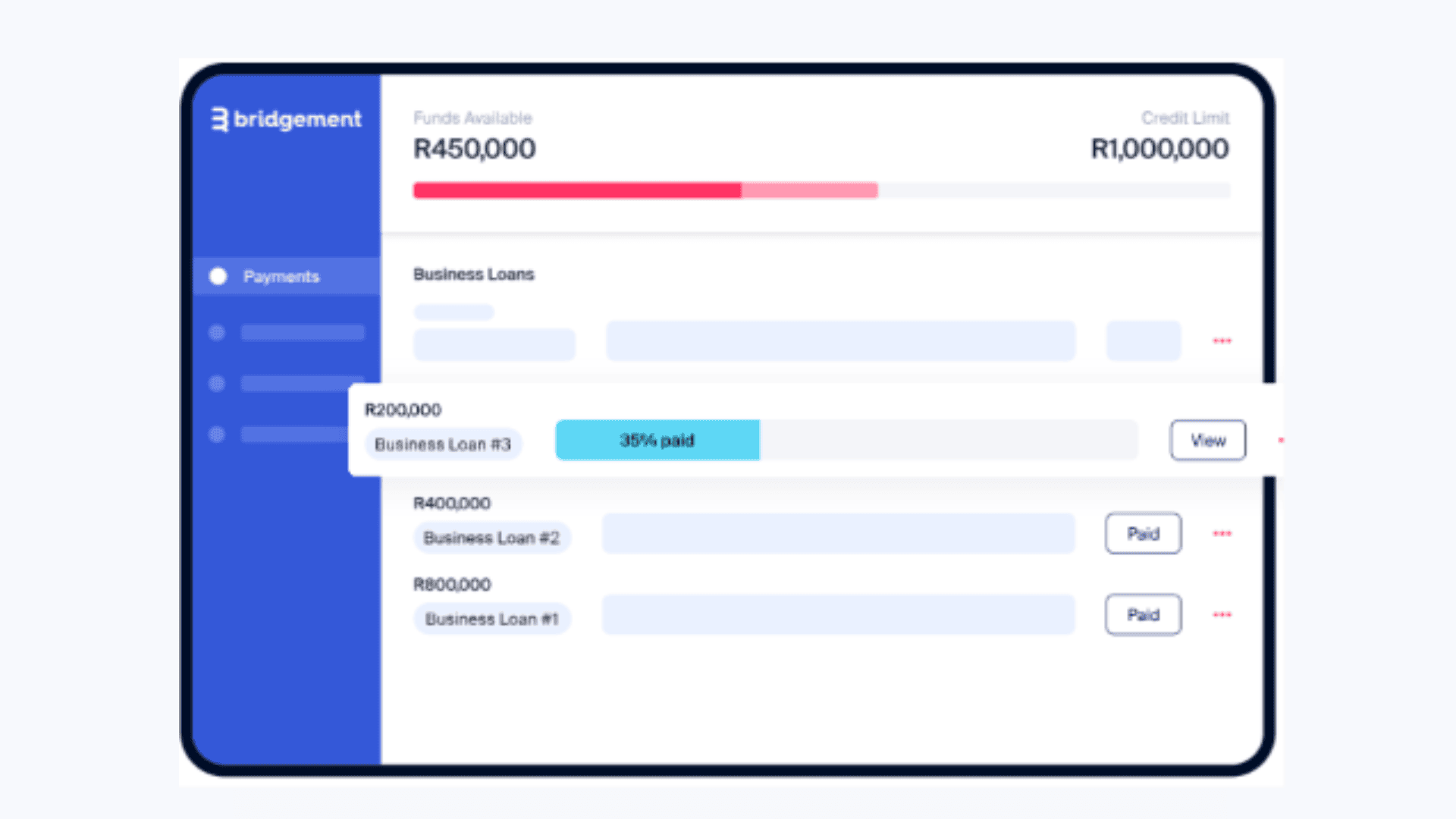
South African fintech Bridgement has raised R330 million ($20.3 million) in funding from Rand Merchant Bank (RMB) and Standard Bank, strengthening its capacity to lend to small and medium-sized businesses while highlighting a growing partnership between traditional banks and AI-driven lenders.
The capital will help Bridgement expand its loan book at a time when access to finance remains one of the biggest obstacles facing South African SMEs.
For established banks, the deal also reflects a growing willingness to rely on alternative credit models to reach businesses that conventional underwriting has often struggled to serve.
That financing gap remains substantial. SMEs contribute about 40% of South Africa’s GDP and account for roughly 60% of employment, yet many still find it difficult to secure credit because they lack audited financial statements, significant collateral, or the predictable cash flows that traditional lending models typically require. Industry estimates place the country’s unmet SME funding demand at between R350 billion and R386 billion.
Founded in 2016 by CEO Daniel Goldberg, Bridgement has built its lending platform around live financial data rather than historical records alone.
The system connects to business bank accounts, accounting software such as Xero and Sage, and other digital data sources to evaluate a company’s financial position. It analyses thousands of financial and operational signals before making lending decisions, often within minutes.
Since launch, the company says it has provided more than R2 billion in financing to South African businesses. Its repayment model is also designed around the fluctuating cash flows common among SMEs, allowing repayments to move more closely with business performance instead of following rigid schedules.
Goldberg argues that speed matters just as much as access. Many businesses need working capital quickly, not lengthy application processes, and he believes analysing live financial data with AI gives lenders a more accurate picture of repayment capacity than relying solely on historical financial statements.
The new funding supports more than Bridgement’s own lending operations. The company also plans to license its underwriting technology to banks and large financial institutions looking to introduce AI-powered lending products without building those capabilities internally.
That strategy helps explain why established banks are backing the company. RMB, an existing partner, says it has supported Bridgement for several years and has watched it consistently expand access to finance for underserved businesses. Standard Bank’s participation further strengthens Bridgement’s position as it scales its technology and lending platform.
The partnership also shows a broader evolution in African financial services. Fintech lenders were once viewed primarily as challengers to traditional banks, competing on speed and flexibility. Increasingly, banks are treating them as technology partners capable of modernising credit assessment and extending lending to customer segments that have historically been difficult to reach.
AI sits at the centre of that shift. By analysing real-time business activity instead of relying exclusively on financial statements prepared months earlier, lenders can build a more current view of a company’s health. That can be particularly valuable for SMEs operating with seasonal revenues or irregular cash flows, where conventional risk models often fall short.
The bigger question is how these models perform when economic conditions deteriorate. South Africa’s economy continues to contend with sluggish growth, infrastructure constraints, and rising operating costs, all of which test credit quality.
With AI-led lending expanding, regulators, lenders, and borrowers alike will be watching how these models balance faster decision-making with prudent risk management.
Bridgement’s latest raise suggests that AI lending is entering a new phase. Rather than disrupting banks from the outside, fintechs are increasingly becoming part of the infrastructure traditional financial institutions rely on. If that model continues to prove itself, partnerships like this could play a larger role in narrowing Africa’s long-standing SME financing gap.
This post was culled from Launch Base Africa.
Don’t miss important articles during the week. Subscribe to Techbuild weekly digest for updates