

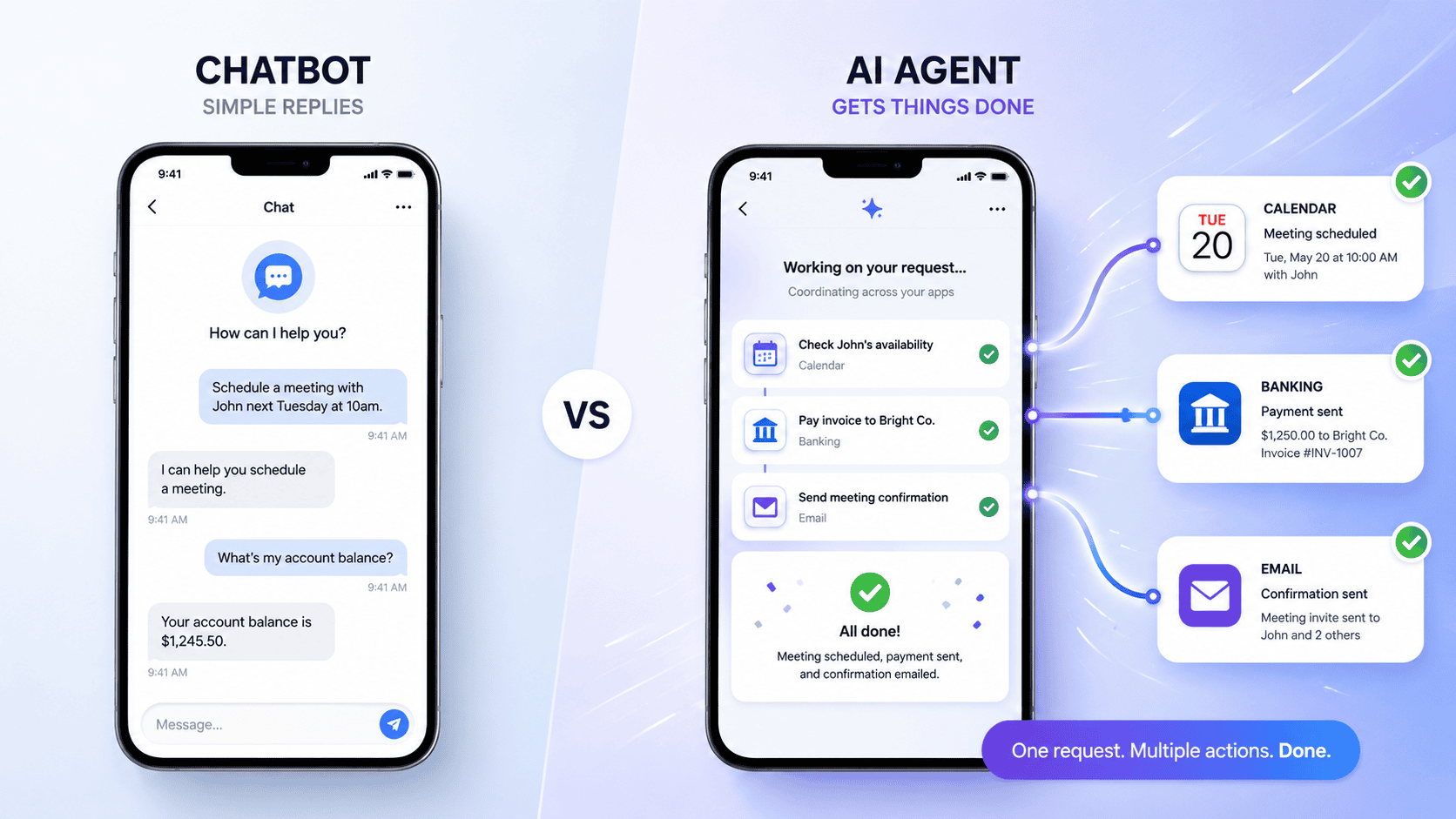
Type “check my balance” into most bank chatbots and you get a menu. Type the same request into Agentpesa, a Nigerian AI-native banking app, in Yoruba, Pidgin or Hausa, by voice, and it checks the balance, flags an unusual transaction and offers to set up a savings reminder; no menu required. That gap between reacting to a message and completing a goal is the entire story of why chatbot and AI agent have stopped being interchangeable terms, even though marketing copy still treats them that way.
What is a chatbot?
A chatbot is a conversational interface over a knowledge base or script. You send text, it returns text, matched to a pre-written FAQ answer, a decision tree or, in its more modern AI chatbot form, a large language model that generates fluent replies from retrieved documents.
Either way, the contract is fixed: text in, text out, and the system only acts when you prompt it again. It does not check other systems, remember much beyond the current session or take real-world action on your behalf.
What is an AI agent?
An AI agent uses a large language model as a reasoning engine inside a loop: observe the request, plan a sequence of steps, call tools or APIs to execute them, evaluate the result and repeat until the goal is met or it gives up.
This is often called the ReAct pattern, meaning reason plus act. The model is one component; the agent also has memory, permissions and access to external systems such as a calendar, CRM, payments API or codebase.
Anthropic’s Claude Agent SDK, for instance, lets developers give Claude a goal and a toolkit, then allow it to run the loop autonomously, checking in only when it reaches a decision that requires human approval.
How agents actually differ from chatbots
The core distinction is autonomy over multiple steps with side effects. A chatbot deflects or informs; an agent resolves. When a task requires reading data from one system, deciding between different paths based on what it finds and writing a result to another system, that is agentic work, not merely conversational work.
Chatbots are also static. The same model deployed in January behaves in roughly the same way in December unless a human manually updates its scripts or knowledge base.
Agents are designed to incorporate new patterns automatically, although how well they actually do this varies enormously by vendor.
Gartner’s research is blunt about the gap between marketing and reality. Of thousands of vendors calling their products “AI agents” in 2026, the firm found that only around 130 verifiably met an architectural standard for genuine agentic behaviour. The rest were largely retrieval chatbots with agent branding, a practice researchers now call “agent-washing.”
Can agents really act independently?
Within limits, yes.
Production agents already draft outbound sales emails, open pull requests when they detect a known bug pattern, reconcile transactions and book calendar slots without a human clicking through every step.
However, independence is usually bounded by permissions. Many agent platforms pause for human approval before carrying out actions with financial or irreversible consequences. Most reputable vendors also build in escalation paths to a human when confidence is low.
Gartner projects that by 2028, roughly 15% of day-to-day work decisions will be made autonomously by AI agents, up from near zero today. That would represent a meaningful shift, although agents would still be making only a minority of workplace decisions.
When to use a chatbot instead of an agent
Chatbots remain the right tool for informational, low-risk and linear requests such as pricing questions, password-reset instructions and order-status lookups. Adding agentic complexity to these cases increases cost without adding much value.
Agents justify their higher price when a request spans multiple systems, requires context-dependent decisions or currently involves a human repeatedly copying information between tools.
Cost is a genuine factor in this decision. Agent-resolved conversations typically cost between $0.30 and $2.00, depending on the model and number of tool calls. A scripted chatbot reply may cost between $0.01 and $0.10. Both remain far cheaper than the $5 to $15 Gartner estimates for a human-handled interaction.
The platform landscape
In 2026, nearly every major technology vendor converged on agents. OpenAI’s Workspace Agents allow teams to build persistent, shared agents inside ChatGPT that can continue working after the browser closes and connect with platforms such as Slack, Salesforce and Google Drive.
Anthropic’s Claude Agent SDK, renamed from the Claude Code SDK once developers began using it beyond software development, exposes the same agent framework that powers Claude Code. It also supports Claude’s computer-use capability, which allows the model to operate a screen directly by clicking, typing and navigating software in a way similar to a person.
Google folded Agentspace into a unified Gemini Enterprise platform in 2026. It also introduced a browser-native agent called Project Mariner and the Agent2Agent protocol for coordination between agents on different platforms.
Microsoft connected Copilot Studio with Microsoft 365 and Azure data through Graph and Dataverse.
Salesforce built Agentforce directly into its CRM, allowing agents to reason over Data Cloud and charging around $2 per resolved conversation. In 2026, it also moved to acquire Intercom, whose Fin agent had already developed a reputation for transparently publishing resolution rates of around 65% to 76% across tens of millions of conversations.
Zendesk, building on its 2024 acquisition of Ultimate.ai, reports lower but still substantial deflection rates, typically between 35% and 45% for well-configured intents.
The common thread is clear: a reasoning loop, tool access and persistent memory are now basic requirements. The competitive question has shifted to which ecosystem an agent can integrate with most effectively.
How African businesses are adopting conversational AI
Nigeria’s banks were early but cautious adopters.
UBA’s Leo launched in 2018, while Zenith Bank later introduced ZiVA through WhatsApp. By February 2024, all 13 Nigerian Deposit Money Banks had deployed AI-powered chatbots.
The challenge is actual usage. A 2024 KPMG survey found that 73% of Nigerian retail banking customers rarely used these tools. This has prompted some banks to reconsider chatbots as internal productivity tools rather than customer-facing showpieces.
Kenya’s Safaricom has taken the agentic model further with Zuri, a generative AI assistant built on AWS and supported by a $500 million AI infrastructure commitment. Safaricom has also invested in fraud-detection systems that act rather than simply provide information.
The more striking case is Agentpesa, a Nigerian digital bank built around an agent-first model. Its voice and chat interface, trained on Yoruba, Igbo, Hausa and Pidgin, replaces menu navigation almost entirely. Users can transfer money, pay bills or receive spending insights through natural conversation, while human escalation remains available around the clock.
Three structural constraints will determine how far this adoption goes.
The first is compute. Africa is home to approximately 18% of the world’s population but holds less than 1% of global data centre capacity. According to World Economic Forum research, only about 5% of the continent’s AI innovators have reliable access to the advanced computing resources required for agentic workloads.
McKinsey projects that African data centre capacity could grow between 3.5 and 5.5 times by 2030, supported by an estimated $10 billion to $20 billion in new investment.
The second constraint is regulation. Nigeria’s 2023 Data Protection Act and Kenya’s National AI Strategy for 2025 to 2030 are pushing agent deployments towards stricter data-residency, accountability and consent requirements. This adds compliance costs that smaller businesses may not have the legal or technical capacity to manage.
The third is jobs. Africa’s business process outsourcing sector is projected to be worth $35 billion by 2028, but it is also one of the sectors most exposed to automation.
Mastercard Foundation research estimates that 40% of BPO tasks could be affected by AI by 2030. Entry-level positions, which make up approximately 68% of the sector’s workforce, face the greatest pressure because more than half of their tasks are considered automatable.
A more measured interpretation, echoed by companies such as ServiceNow operating in the region, is that agents will reorganise jobs around supervision, exception handling and complex problem-solving rather than eliminate customer-service work entirely.
However, that transition will not be even. Entry-level recruitment is likely to experience the pressure first.
What comes next
Three major shifts are likely over the next few years.
The first is consolidation, as major technology platforms acquire specialist agent companies in the same way Salesforce moved towards acquiring Intercom.
The second is a narrowing of the agent-washing gap. Buyers will become better at testing claims of autonomy rather than trusting a product simply because it carries the “agent” label.
The third, particularly in Africa, is a widening divide between businesses that can afford reliable computing power, integrations and compliance infrastructure and those that remain priced out of the agent economy.
The direction of the technology is clear. Whether it closes Africa’s productivity gap or widens the digital divide between well-resourced and under-resourced firms will depend far more on infrastructure investment, workforce preparation and regulation than on the models themselves.
Don’t miss important articles during the week. Subscribe to Techbuild weekly digest for updates