

Meta is introducing a new way to interact with its AI assistant inside WhatsApp that reframes how tech companies think about data and generative AI.
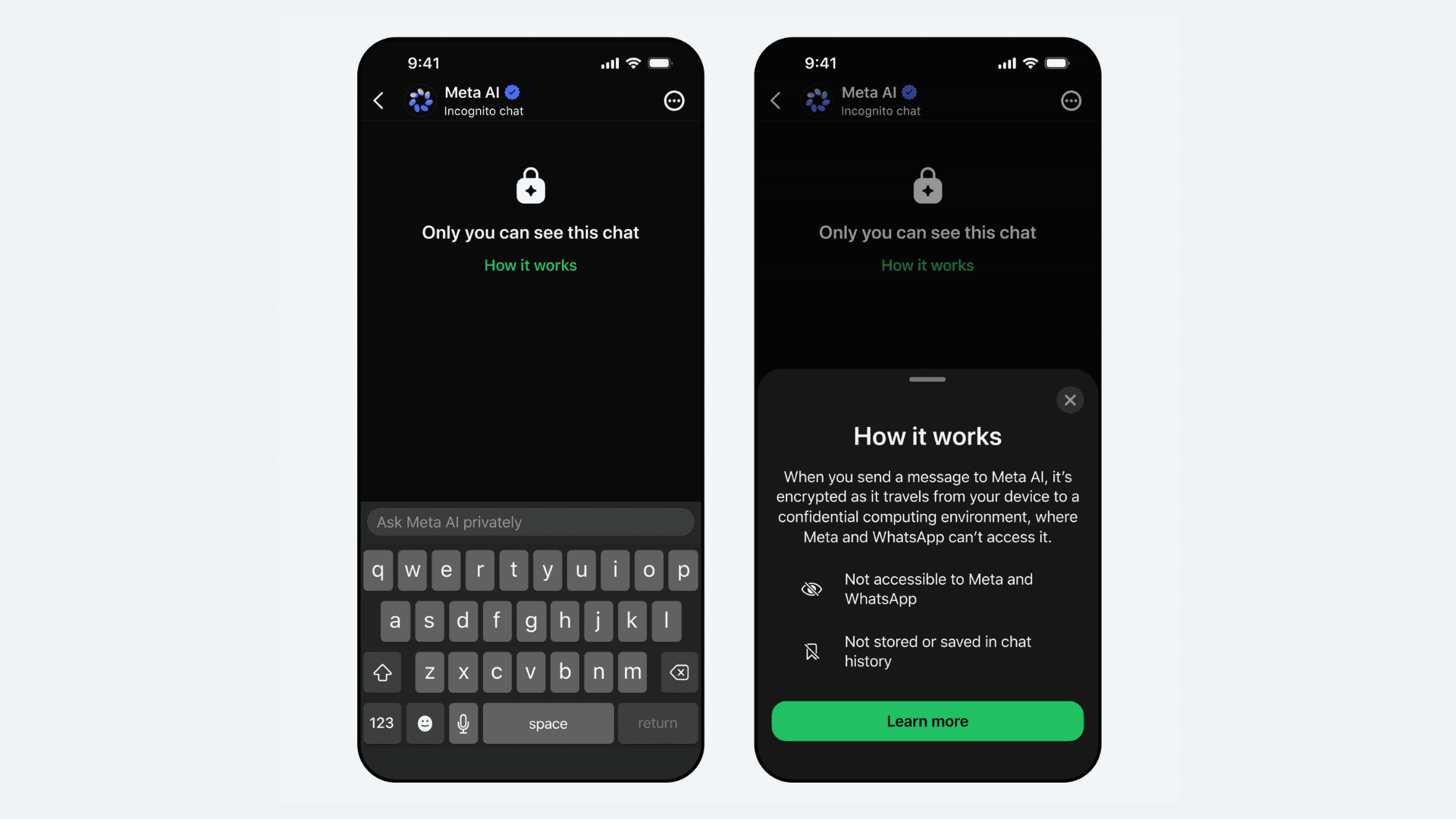
The feature, called Incognito Chat, creates temporary AI conversations that disappear and remain inaccessible even to the company itself.
The announcement focuses on privacy, yet the more interesting shift lies in what Meta appears to concede: AI products struggle to win trust when users assume their conversations become training data.
AI conversations people never meant to store
Meta says people often ask AI systems questions they would hesitate to ask a search engine or post publicly. Those questions range from health concerns to financial decisions or personal dilemmas.
Incognito Chat attempts to address that behavior directly. When users start an incognito session with Meta AI, the conversation runs inside a protected computing environment that prevents the content from being logged or viewed by Meta’s systems. Messages disappear after the session ends, leaving no stored record of the exchange.
The architecture builds on WhatsApp’s “Private Processing” infrastructure, which runs AI inference inside trusted execution environments designed to isolate sensitive data from the rest of the company’s systems.
The practical result is simple. The AI still processes the request and produces a response, yet the conversation itself never becomes part of Meta’s data pipeline.
A quiet admission about AI trust
I read the feature less as a technical breakthrough and more as a signal about how the AI market is changing.
Generative AI companies spent the last two years telling users to treat chatbots like assistants. Many people did. They shared personal problems, work dilemmas, financial questions, and health concerns.
The industry then had to explain that these conversations could be stored, reviewed, or used to train models.
Meta’s move suggests the company believes that tension has become a barrier to adoption.
Other AI platforms offer “temporary chats,” yet many still retain logs for limited periods or allow human review for safety monitoring. Meta claims its incognito mode avoids server-side storage entirely, positioning it as a stricter privacy model.
Whether that claim holds up under scrutiny will depend on outside audits and real-world testing.
Messaging apps are becoming AI operating systems
The launch also hints at how messaging apps are turning into the distribution layer for AI assistants.
Meta plans to expand the concept with a feature called Side Chat. That tool would allow users to consult Meta AI privately while discussing something in an existing WhatsApp conversation.
The assistant could analyze the context of a chat and offer suggestions without inserting itself into the main thread.
If that works as intended, it pushes AI further into the background of everyday communication.
WhatsApp already functions as infrastructure for billions of conversations. Embedding AI into that environment, while promising strict privacy controls, could accelerate how frequently people rely on AI for everyday decisions.
Privacy as competition
The deeper context sits in the broader AI race.
Companies building chatbots need more usage, yet the most valuable interactions tend to be the ones users hesitate to share. Private AI sessions attempt to remove that friction.
Meta bets that a system designed to forget conversations might encourage people to ask the questions they currently avoid.
Whether users believe the promise is another matter. Privacy claims from large platforms often meet skepticism, especially when those companies depend on data-driven business models.
Still, the direction is clear. AI products increasingly compete on how little data they retain rather than how much they collect.
That shift alone says a lot about where the industry thinks the next adoption barrier lies.
Don’t miss important articles during the week. Subscribe to techbuild weekly digest for updates