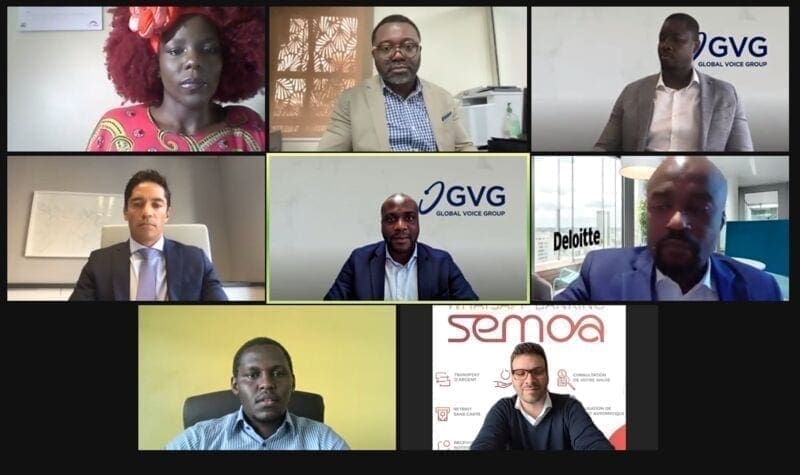
Recently, Global Voice Group and CIO East Africa hosted a webinar to explore Africa’s race towards a cashless society, through the eyes of public and private sector actors across the continent.
The virtual event was themed, “The Race Towards Cashless Africa”, During the webinar which took place on Thursday, April 15, 2021, the discussion was centered around the challenges, opportunities and growth of digital money on the African continent.
The speakers at the Cashless Africa virtual event include Aristide Ouattara, Business Lead Advisory, Deloitte Afrique; James G Claude, CEO of Global Voice Group; Bernard Ewah, DD, e-Government Development and Regulation NITDA; Andrew Mutua, Founder, CEO Pesakit; Sofien V. Sidhoum, Investment Manager and Venture Builder, Vertis Capital.
Here are some of the takeaways from the Cashless Africa virtual event:
Cash transactions still prevail, due to a huge informal sector excluded from financial services
2 billion workers (61% of the world’s employed population) are in informal employment
Over 80% of workers in SuB-Saharan Africa find their livelihoods in the informal sector
Why cash is still prevailing
- Cash is easy to understand
- Cash is trusted
- Cash is so culturally entrenched that it doesn’t require learning new behaviors
- 95% of transactions in Nigeria are currently cash-based and 60% of adults are without bank accounts
Implications of cash
- Cash challenges safety because it is anonymous. it is the case of money laundering in the absence of a digital paper trail
- Cash is costly for states however it is difficult to monitor and expensive to produce
- Cash constrains socio-economic innovation and development however, digital money flows enable greater financial inclusion
Widespread use of digital finance has the potential to boost the annual GDP of emerging economies by US$3.7 trillion by 2025, however, digital Financial Services (DFS) can only gain prevalence with the right technology and infrastructure.
The value of a cashless society
- For governments- Drop in money laundering and other illicit activities, improve market oversight and efficiency, no expenses associated to manufacture
- For citizen- a safer financial transactions ecosystem increases financial accessibility
- For society – it contributes towards sustainable economic development
The world bank estimates that 1.1 billion people in the world are not able to prove who they are.
Trust economy
- Without a secure economic system, financial exchanges become impossible
- Financial institution play a fundamental role as a link between traditional banks and fintech
- To foster trust in the digital ecosystem regulation is key
There is still a long path towards the full digitization of Africa, however, COVID-19 has contributed to an increase in digital transactions
Migration towards a cashless society
Increase the pace of transactions and demand compliance monitoring tools that can safeguard the whole ecosystem, while protecting all stakeholders.
Towards improved interoperability which is key for financial inclusion
Interoperability in DFS is the ability of a digital financial service to make and exchange specific kinds of information often in the form of transactions across a number of financial service providers.
It empowers users to transfer money from one network to another – enhancing safety, promoting affordability (especially among low-income groups), encouraging financial inclusion.
Don’t miss important articles during the week. Subscribe to techbuild.africa weekly digest for updates.