



• Home
  • About
  • Advertise
  • Contact
  • Signup to receive updates
 Innovation | Startups | Funding | Tech Blog in Africa
NiRA Event
  • Home
  • Startups
  • Opportunities
  • Funding
  • Women Tech
  • Expert Column
  • Blockchain
No Result
View All Result
  • Home
  • Startups
  • Opportunities
  • Funding
  • Women Tech
  • Expert Column
  • Blockchain
No Result
View All Result
Innovation | Startups | Funding | Tech Blog in Africa
No Result
View All Result
Home General

Potentially Unwanted Applications now Surpassing Malware Attacks in Africa – Kaspersky

by Dare Afolabi
6 years ago
in General
Reading Time: 2 mins read
A A
PUA

PUA

Share on FacebookShare on Twitter

RelatedPosts

Meta Expands Safety Features for Nigerian Teens and Parents at Abuja Event

6 Ways Google and Gemini Are Changing How Fans Enjoy the 2026 World Cup

Paystack Targets Nigerian SMEs With New Support Programme

AWIEF Announces Pitch n Grow 2026

In Nigeria, there were 3.8 million malware attacks and 16.8 million Potentially Unwanted Applications (PUA) detections

Kaspersky security solutions have reported on 28 million malware attacks in 2020 and 102 million detections of potentially unwanted programs (pornware, adware etc.) they have accounted for by the beginning of August 2020.

These numbers show that it’s not only the malware that attacks users but also the “grey zone” programs that grow in popularity and disturb their experiences, while users might not even know it is there.
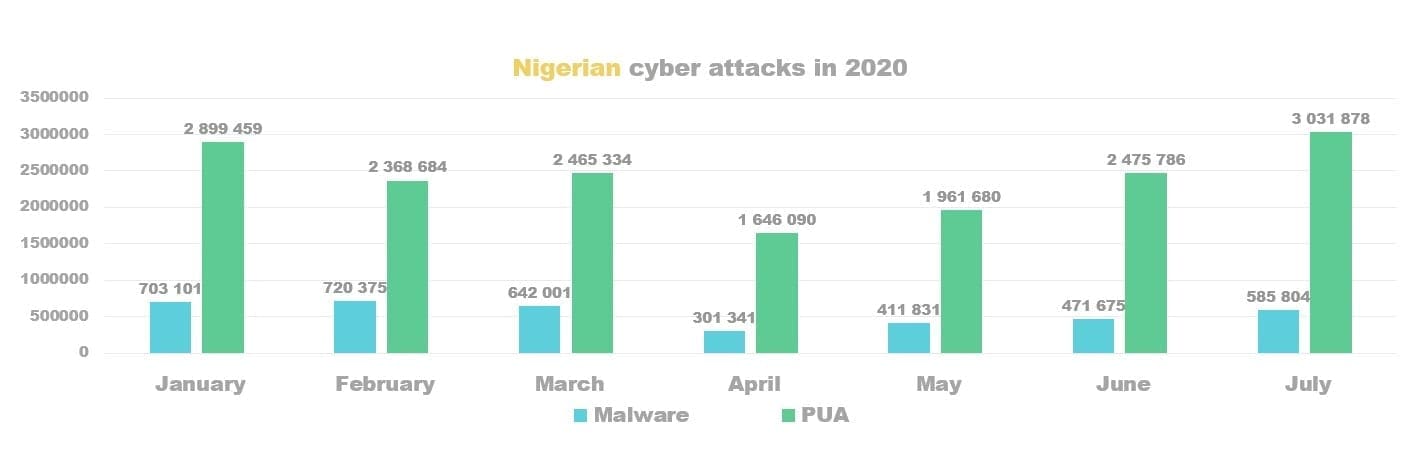
Nigerian cyber attacks

Potentially unwanted applications (PUAs) are programs that are usually not considered to be malicious by themselves. However, they are generally influencing user experience in a negative way.

For instance, adware fills user device with ads; aggressive monetising software propagates unrequested paid offers; downloaders may download even more various applications on the device, sometimes malicious ones.

While calculating interim results of threat landscape activity in African countries, the researchers noticed that PUAs attack users almost four times more often than traditional malware.
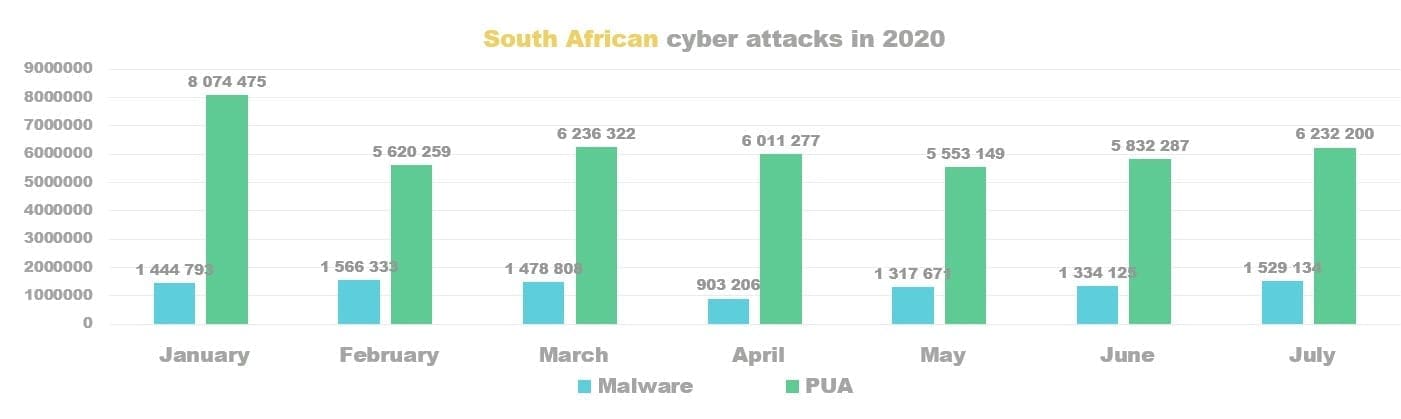
South African cyber attacks
South african cyber attacks

They also eventually reach more users: for instance, while in South Africa, the malware would attack 415,000 users in 7-months of 2020, the figure for PUA would be 736,000.

Denis Parinov, a security researcher at Kaspersky, commented:

“The reason why ‘grey zone’ software is growing in popularity is that it is harder to notice at first and that if the program is detected, its creators won’t be considered to be cybercriminals.

The problem with them is that users are not always aware they consented to the installation of such programs on their device and that in some cases, such programs are exploited or used as a disguise for malware downloads.

This is why many security solutions, including ours, flags such programs to make sure users are aware of its presence, influence on their device and activity,”

By taking a closer look at PUA, it becomes apparent that they are not only more widespread but also more potent than traditional malware.

Kenyan cyber attacks

Evaluating results over the same 7-month period in Nigeria, there were 3,8 million malware attacks and 16,8 million PUA detections – which is four times as much.

Kenyan and South African threat landscapes have been more intense. In South Africa, there were almost 10 million malware attacks and a staggering 43 million PUA detections. Kenyan users faced even more malware attacks – around 14 million, and 41 million PUA appearances.


Featured Image:blog.finjan


Don’t miss important articles during the week. Subscribe to cfamedia weekly digest for updates.

Join @techbuildafrica on Telegram
ShareTweetShareSendShare

Related Posts

Meta
General

Meta Expands Safety Features for Nigerian Teens and Parents at Abuja Event

World Cup
General

6 Ways Google and Gemini Are Changing How Fans Enjoy the 2026 World Cup

Paystack Small Business
General

Paystack Targets Nigerian SMEs With New Support Programme

Subscribe Us

Recent Posts

  • Beyond More Money: Why Africa Needs Smarter Capital Deployment
  • Meta Expands Safety Features for Nigerian Teens and Parents at Abuja Event
  • Grey Expands Cross-Border Offering With Four New Currency Payout Options
  • 6 Ways Google and Gemini Are Changing How Fans Enjoy the 2026 World Cup
  • Paystack Rolls Out Paystack Index, Bringing AI Into the Checkout Experience
  • WhatsApp Now Flags Unfamiliar Numbers Before You Open a Chat
  • After Years in Regulatory Limbo, Zimbabwe’s Crypto Industry Gets a Formal Rulebook
  • The Bigger Crypto Security Problem Isn’t Billion-Dollar Hacks Anymore
  • RoboCare Lands Investment From 216 Capital to Expand Its Farm Intelligence Platform Beyond Tunisia
  • Football Podcasts Gain Momentum Across Sub-Saharan Africa, Spotify Reveals

Telegram

Join @techbuildafrica on Telegram
Innovation | Startups | Funding | Tech Blog in Africa

© 2013-2024 techbuild.africa. All Rights Reserved.

Navigate Site

  • About
  • Contact
  • Privacy
  • Sitemap
  • Terms
  • Blockchain
  • CleanTech

Follow Us

Welcome Back!

Login to your account below

Forgotten Password?

Retrieve your password

Please enter your username or email address to reset your password.

Log In

Add New Playlist

No Result
View All Result
  • Home
  • Startups
  • Hubs
  • Funding
  • WomenTech
  • CleanTech
  • Blockchain

© 2013-2024 techbuild.africa. All Rights Reserved.

This website uses cookies. By continuing to use this website you are giving consent to cookies being used. Visit our Privacy and Cookie Policy.
Secret Link