


Within an enterprise, a wholesale culture shift is needed for digitalisation to take hold and get used to its full efficiency-boosting potential
It has been said over and over by a multitude of business systems experts.
One of the greatest barriers to digital transformation is not technological. It is human resistance to change.
Within an enterprise, a wholesale culture shift is needed for digitalisation to take hold and get used to its full efficiency-boosting potential.
Of course, enterprises are now operating in a context of forced, unprecedented change beyond the scenarios covered in most business continuity plans.
Who projected that we would one day be in a situation where essentially everything would close at the same time, crippling supply chains?
Or that a company’s workforce would get mandated to stay home, with no access to on-premise systems?
Businesses need new solutions to ensure business continuity in the current economic climate, recover quickly and ensure operational resilience in the “next normal” beyond COVID-19.
The time is ripe for change, but it demands a greater embrace of new perspectives.
These newer attitudes have been slowly taking root in Africa.
First, there was the move from manual to automated Enterprise Resource Planning (ERP) applications.
This led to the realisation over the past decade that cloud-based systems drive greater operational agility than their on-premise equivalent, allowing enterprises to operate efficiently and securely, even across borders.
As an example, Bank of Kigali Plc in Rwanda has leveraged cloud-based functionality such as end-to-end process automation to reduce costs, improve scalability and innovate customer offerings.
Despite such success stories, many companies continue to cling to the mindset of “I have my own customised ERP, and it works for me; I’m not giving it up.”
That attitude is understandable, but current challenges prove traditional ERPs lack the flexibility to overcome them efficiently. Rigidity is simply not contemporary best practice.
Even before the current crisis, Steve Cox, Oracle’s Group Vice President for ERP EPM Product Marketing, referred to the future of best practices as being one of less work, more automation and better outcomes.
The wider business context has, of course, shifted, but evolving technology remains key to unlocking business benefits, such as greater speed and cost savings.
The future of best practices is also continually get disrupted and redefined by emerging technologies.
We see artificial intelligence (AI) and machine learning (ML) well entrenched in Oracle Cloud applications now, producing insights from big data, automatically maintaining systems and underpinning chatbots.
Becoming similarly commonplace in enhancing everyday work processes are the likes of blockchain, Internet of Things (IoT) and augmented reality (AR), with the first two having special advantages for supply chain management (SCM).
Even with expensive IT upgrade cycles, old on-premise platforms may battle to integrate with such new solutions.
By contrast, through cloud, enterprises can instantly leverage the latest best-in-class technologies, which connect seamlessly because of already considered integration capabilities.
The cost of continual upgrades goes away, and it becomes easier to predict spend and calculate budgets.
With continual cycles of disruption the new business “normal,” the ability to accurately predict and prepare has become the best practice for enterprises.
Cloud ERP offers users the ability to effortlessly pull together data sets across a business for better insights that drive scenario planning and optimisation strategies.
At the same time, an organisation’s human talent gets liberated to focus on innovation instead of losing their workdays to mundane manual tasks like report generation and transaction processing.
Leveraging these capabilities, and more, does not require reinventing the wheel.
To make an enterprise truly future-ready, and minimise unpredictable risk, starts with overcoming attitude barriers.
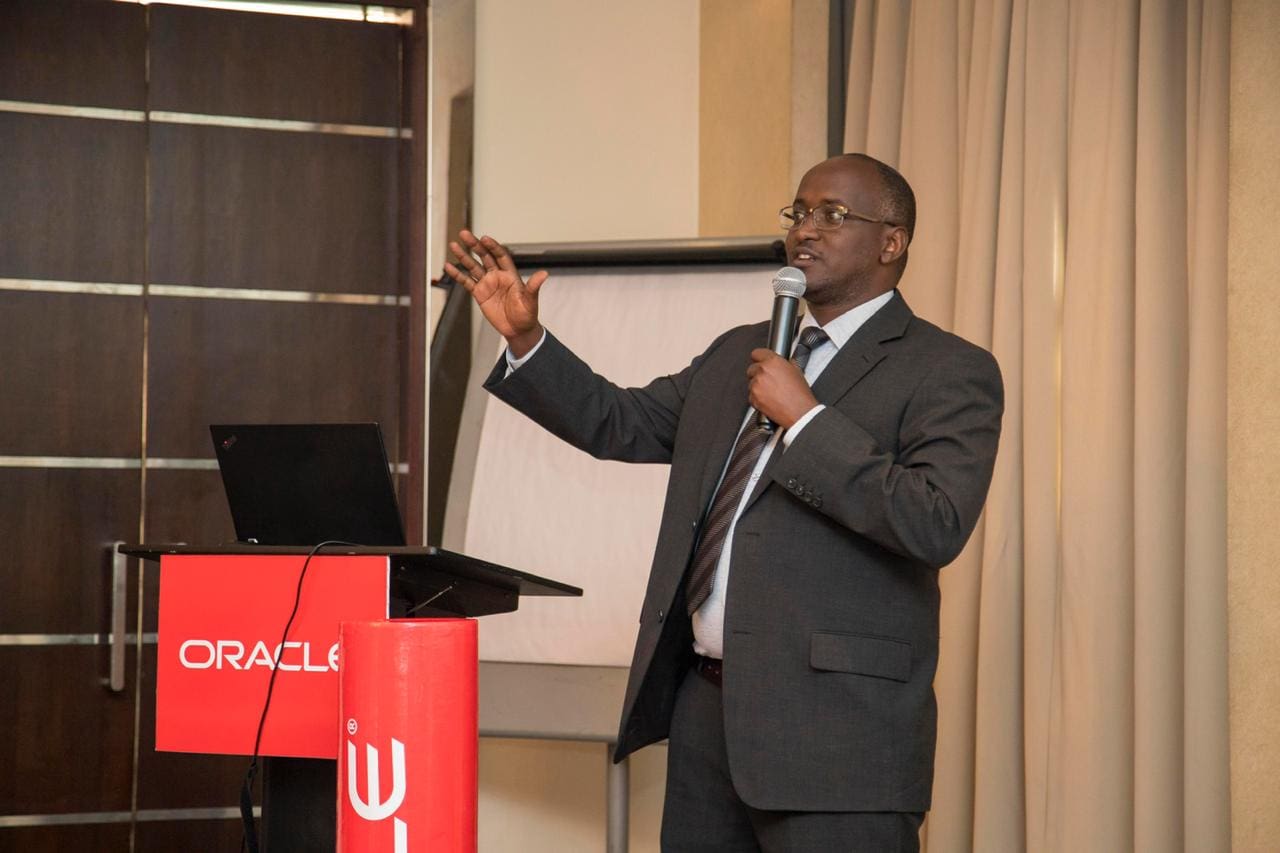
Featured Image: Dr. Ibrahim Abduba, ERPM Strategy and Business Development Leader, East & West Africa at Oracle
Don’t miss important articles during the week. Subscribe to cfamedia weekly digest for updates.