

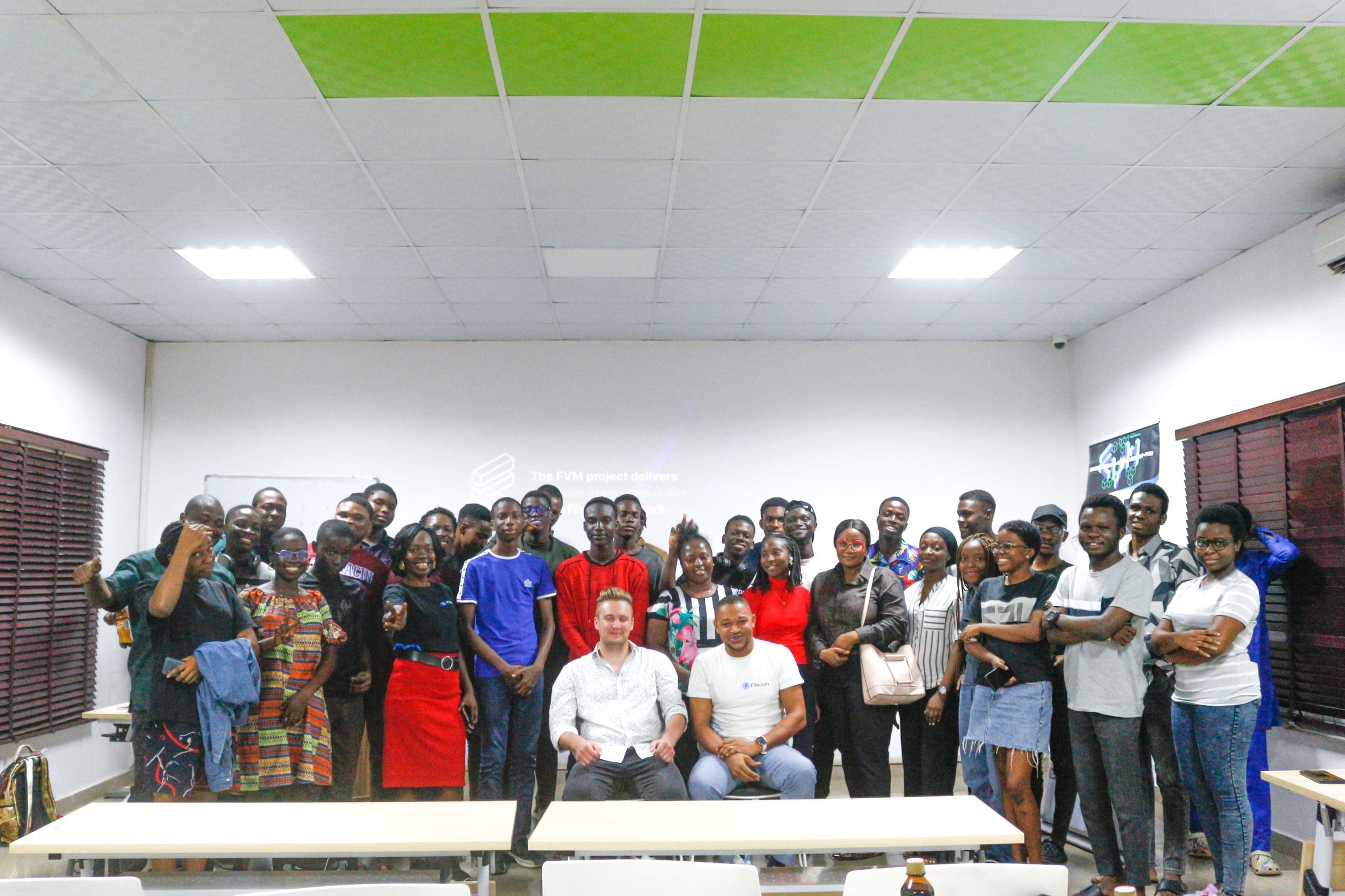
Ethereum Nigeria through the Filecoin Orbit Community Lagos recently hosted Robert Dowling, the renowned blockchain expert and Program Manager for Filecoin Foundation at a workshop hackathon at the NITDA IT Hub, University of Lagos.
Robert Dowling in his first-ever visit to Lagos discussed Filecoin’s world of decentralized data storage and its boundless opportunities.
Recall that Filecoin Africa the umbrella body of the Filecoin Orbit Community Lagos announced the Filecoin Virtual Machine Road Show, a series of workshops that will span across several African countries.

The Lagos workshop hackathon gathered developers working around web3, blockchain, and smart contracts who are ready to explore the possibilities offered in the Filecoin ecosystem.
Robert commenced the workshop with a brief on the cryptocurrency ecosystem (using Bitcoin and Ethereum as case studies), discussing both its monetary and technological value.

Moving on, Robert addressed the issue of data privacy as related to the blockchain, he acknowledged that Bitcoin for instance provides for a new privacy model where transactions are publicly available, but accounts are anonymous.
He gave instances of how global exchanges like Coinbase ensure they are collecting identifying information on users, however, there are questions to be asked. “Given the current dynamic between big techs and law enforcement, how should blockchain protect/not protect illicit activities?”, “Who is responsible for breach of duty and injury when there is no authority and no duty?”

Stating further, Robert touched on the challenges of a centralized web that leverages location addressing through the internet to find users’ information.
The decentralized web on the other hand through content addressing would find information without its location. This is where Content Identifiers (CIDs) come in through the IPFS.

As explained by Robert, the IPFS is a p2p networking protocol used to share data on the distributed web.
The centralized web we have today according to him is insufficient, expensive, can’t preserve human history, comes with limited opportunity and requires backbone connectivity.
How is the IPFS up to the challenges mentioned above? Robert explains:
Efficient and cost-effective – IPFS retrieves pieces from multiple nodes at once, enabling substantial bandwidth savings, With up to 60% savings for video. IPFS makes it possible to efficiently distribute high volumes of data without duplications
Preserving human history – The average life span of a webpage is 100 days, with IPFS, users can set up resilient networks for mirroring data, and because of content addressing, files stored using IPFS are automatically versioned.
Boundless opportunities – While no doubt that the internet has been a great equalizer in human history, its increasing consolidation of control threatens that significant progress. IPFS has come to deliver an open and flat web.
Backbone connectivity – IPFS powers the creation of diversity resilient networks that enable persistent availability – with or without internet backbone connectivity.
Lastly, Robert touched down on the Filecoin Virtual Machine (FVM), reiterating its significance because it enables developers to customize what the Filecoin network can do for its users, besides storage and retrieval.
What becomes possible with FVM?
- Storage provider market loans
- Perpetual storage deals
- Programmable storage tools
- Token, bridges and L2 networks
- Decentralized access controls
- Data DAOs
- Compute over data
“For the first time, developers get to build not with Filecoin, but rather on Filecoin as a platform”, Robert added.
Don’t miss important articles during the week. Subscribe to blockbuild weekly digest for updates.