

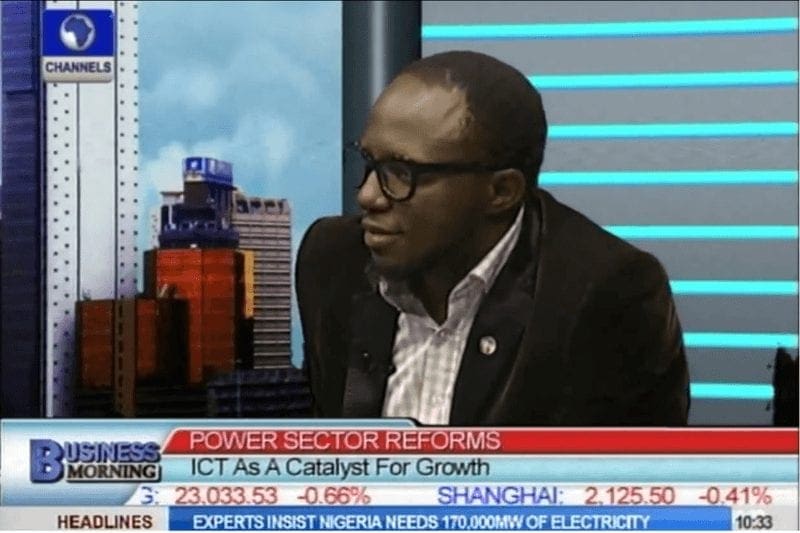
Harriet: well, as I said, our conversation on the program today is going to be focused on how information communication technology can be a major component in the strategic development of the power sector & I am being joined on the program by two ICT experts, I would like to call them experts, young they may be, already they are experts in their fields, Fred Agbata and Jude Mgbaka. Thank you so much gentlemen for coming on the program this morning.
Jude & CFA: It’s a pleasure, thank you very much.
Harriet: well, Fred you have been to my show before, let me leave the honors to Jude this morning.
Harriet: JUDE, We noticed that, let’s just do a little background before we come in & see how much , your kind of, what you do ( yes ), what you specialize in on how ICT can contribute effectively to improve the power sector. Now last year, the federal government (you know) took that bold step and privatized the power holding company of Nigeria, distributing companies & generating companies. Now based on, in terms of attracting investments, can you just hazard a guess of how much the country has gained?
Jude: From using the ICT impact?
Harriet: No just before we get to that, let’s just have a little knowledge of what the industry is at the moment & then we’ll begin to look at how much the ICT has actually contributed? If it has!
Jude: Okay, essentially as it is now (right), I think what we have on ground, is the power grid that has been used since the inception. So this structure essentially has little or nothing to do with ICT. It just generates power, distributes. So, international ICT awareness is essentially new. So we don’t have technology to have the technology tools to apply to the power sector assistance today. So we are at the IT inceptions. This is not a Nigerian thing; globally the world still stands to look at how to bring ICT into the power sector because the power sector is special in its nature. So for us it means that we can start off from where we are. So it’s a great opportunity but it must be said that not much has been done. So what it means is just opportunities.
Harriet: hmmmm….just opportunities, then how can ICT now be a catalyst, to actually aid growth of the power sector if you say that not much has actually been brought in?
Jude: if you look at the power sector, the biggest challenge is efficiency. That means if you generate power & then you transmit, you distribute and then you send to users. There is no way of storing the power in between the production & distribution. And it has to get to exact consumption points. So what it means is that you need to have intelligence that should be able to manage things like off peak & no usage periods within the day. So intelligence essentially is where I see that ICT can come in.
Harriet: Okay.
Jude: So when you, see like hundred years ago, when we were in the mechanical age, intelligence were handled mechanically, so you have things that could switch on and switch off and then eventually came to the era of electronics. Now we take ICT, we have intelligence electronics run by and powered by software which is able to, which is installed to generate, distribute & then able to manage the usage of power. It then regulates the consumption of power based on needs.
Harriet: Okay, so Fred, from what he just said now, does it seem as if ICT has actually had more impact in terms of promoting energy efficiency?
CFA: Yes, I think taking it from where he stopped talking about the smart grid, and talking about the fact that it’s still very low. But the point is that when the one of the administrations came up with a smart material that was a good step. Now the truth of the matter is you need ICT to be able to create the efficiency within the power sector especially where Nigeria is and the kind of challenges that the new guys have to face, what they’re doing with this power, I mean this system, it’s a lot that needs to be done, a lot, in fact, a lot of things need to be changed from the transmission cables to a lot of equipment, the power grid have to become smarter above all, where the energy companies are trying to view the smart grid, one of the projects within Nigeria. That’s the way to go. You have to think about power from the point of generation, transmission, distribution & consumption. We need ICT to completely rule in all these areas and that’s how the efficiency can be achieved.
Harriet: So if we are going to construct a smart grid, that means you are carrying more costs and that means the end users, at the end of the day has to pay more. And right now they are complaining that, you know, what they have to pay is too much and they have not even seen the electricity and so I don’t know what they’ll do when the smart grid comes up. They’ll now have added expenses.
CFA: I think there would be no way it would be compared to the cost of running Diesel & Generator. That’s on one hand. Now, but the point is, there is no way that the costs will not stabilize over time. It will stabilize but for the guys, the new guys need to get it right. They must invest in new smart grid that’s the reality on the spot.Now, why do we need smart grid? You need to protect the grid. But if you don’t have ICT in mind from the onset, how can you protect a transmission cable that was viewed without ICT in mind. But with ICT, a transmission cable can actually be protected, at least it will let you know, it will signify to you when there is an intrusion and it will also signify to you where the exact point the extrusion took place and at what time. So thinking about the 21st ICT, you need ICT to make this work.
Jude: Let me just add, I think he is trying to explain how this smart grid works. Just imagine in normal network, a computer network in an office. If there is supposed to be communication between two systems, if one is off, immediately the other will stop too. The guy can’t receive whatever he is transmitting over the network. That’s how the smart grid is supposed to work. So, essentially you have nodes in between two networks that are able to tell this. Imagine that, how it is now if my cable is down. In fact, sometimes, I have to call the agencies that my cable is down. They don’t know. And this is not efficient because once you become private. They can do it over a year because we know its government. We say well “that’s how they work”, but if I am dealing with a private company and I am paying you for the services, I want to see it working efficiently. If the cable is down, I can get that service immediately.
Harriet: Which means that the private sector now needs to have a new plan attached to the one they already have in terms of how to ensure that all the insulation they are going to have, all the pipes are going to run, the transmission cables, all the rest of it are properly monitored and it’s not everything that human factor is not always a very interesting thing to play with in times like this.
CFA: Yes, most certainly I am sure that they are starting off to understand they need to work a little with ICT experts, security experts to help them to do the foundation because what they have now are obsolete. I am sure they know that they need to start changing most of these equipment, changing the transmission cables.
Harriet: Yes, because most of them are obsolete.
CFA: Very obsolete.
Harriet: In fact this summit that just ended, the seventh legal economic summit. That was the only thing that actually highlighted the fact that most of equipment are actually obsolete.
CFA: I saw coming here this morning, a cable fell across the road & it caused a bit of traffic problem and I am sure that’s what we’re talking about. If it was a smart cable or either a node was attached to it, the guys will have already known, because it happened last night & by this morning it will have been off the road. Now, let me also talk about one other point you raised. Now, if I am a consumer & I brought a bill. And if I have smart metering system and I consider the bill actually reads what I consumed, I would have no problem paying. Why I would complain is if the meter is not read and I am given a guessed bill. If there is a way that the consumer can actually match what they’ve consumed to their bill, they would happily pay the bill because they cannot compare the cost of running diesel to whatever costs the power guys have brought, plus the reduced the noise pollution.
Harriet: Let’s put a figure to this smart grid that you are talking about? How much will it cost, realistically, to actually put up a smart grid?
Jude: Okay, fine, I think it depends on the level of integration. Okay, how far you want to take it because this can get as far as from the grids themselves to the smart metering, to actually monitoring the actual use of appliances within the homes.
Harriet: Okay.
Jude: So, this figure I can’t place right now, but it depends on how far the users are now willing to go or what they are willing to do.
Harriet: Oh but, no, I would take you up on this one because nobody in this wants to make any loss & nobody is in this to fail, it’s a risk they are all taking, granted, but then they want to ensure that if there was a success in this sector after this kind of privatization they want to be named, they want their names to be called when the success of the sector is called. And so, coming into this atmosphere as it is, they want to make sure that they make profit but at the same time satisfy the consumers and they are ready to go to any length. Like one of the participants in this session actually said that money is not really an issue for them because some of them actually came in with their personal finance just to make sure that the business begins to move. And so, that is a strong commitment, so, a stronger commitment for instance can be shown in terms of smart grids. Do you think that this problem will be quickly reduced?
Jude: Yes, I am excited to hear that. I mean, I know, as far as they brought some big amount of money to make this.
Harriet: And massive equipment as well.
Jude: Yes, exactly, but the thing is this, when it comes to actual implementation of smart grids and then bringing ICT totally to control/manage the system as far as power is concerned is required both in term of bringing in ICT experts and what they spoke about the infrastructure itself. Now, this is a lot of money. Now if you are going to back this project, it means that you are looking at the future. You can’t talk of immediate profits because there is no background for what we are about to go into. It’s a totally new platform that needs to be operated.
Harriet: But this is not something that people haven’t done, other countries have not practiced it before.
Jude: Yes, even those who have done it right are looking for how to move forward, that’s why I say for us, we don’t have to do the history. We can’t just go into the future with that. so the latest technology is what we should be looking at bringing in. So, what is happening in the US for example, what are they implementing? I’ve seen at conferences in the US where they are thinking of taking it, off course there are resistance to some of these things. Like the monitoring will be too much because when you know exactly when I switched my AC on, that is knowing too much about me or how I am living. Where they are, right now, is where we should start from because having/starting a lead is opportunity for us. Because we know we should start exactly where they are and then do the best, and that is a whole lot of money and for me, I think the investors should think digitalize. That is the advice. That you should be thinking futuristically.
CFA: I think I will like to make a point. Did you analyze that the money they need? What they have now, I am sure, is child’s play because I’ve heard the minister asking them to go to the stock market to raise funds, because when you talk about smart grid, it’s going to cost a whole lot. Generally, in the ICT industry we can’t just put a figure to a plan because we need to understand what the job is, but the point is taking the right steps, the right strategies is good for bonding to this. Now, about the next thing is ‘ how we begin to implement these so-called ICT strategies to ensure that “our power becomes efficient” and also to change the habits of the average consumers in terms of how they manage the electricity.
Harriet: Okay, let’s talk about that when we come back. Let’s take a quick break and catch our breath. Well, for those who are watching, this is BUSINESS MORNING on CHANNELS TELEVISION and today on the program we are looking at how ICT can be a major component in this strategic development of the power sector.
We’ll be right back.