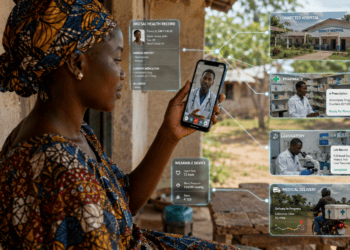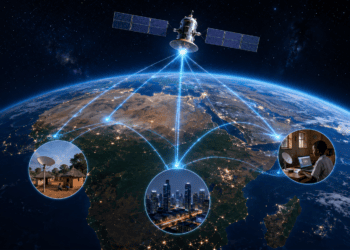


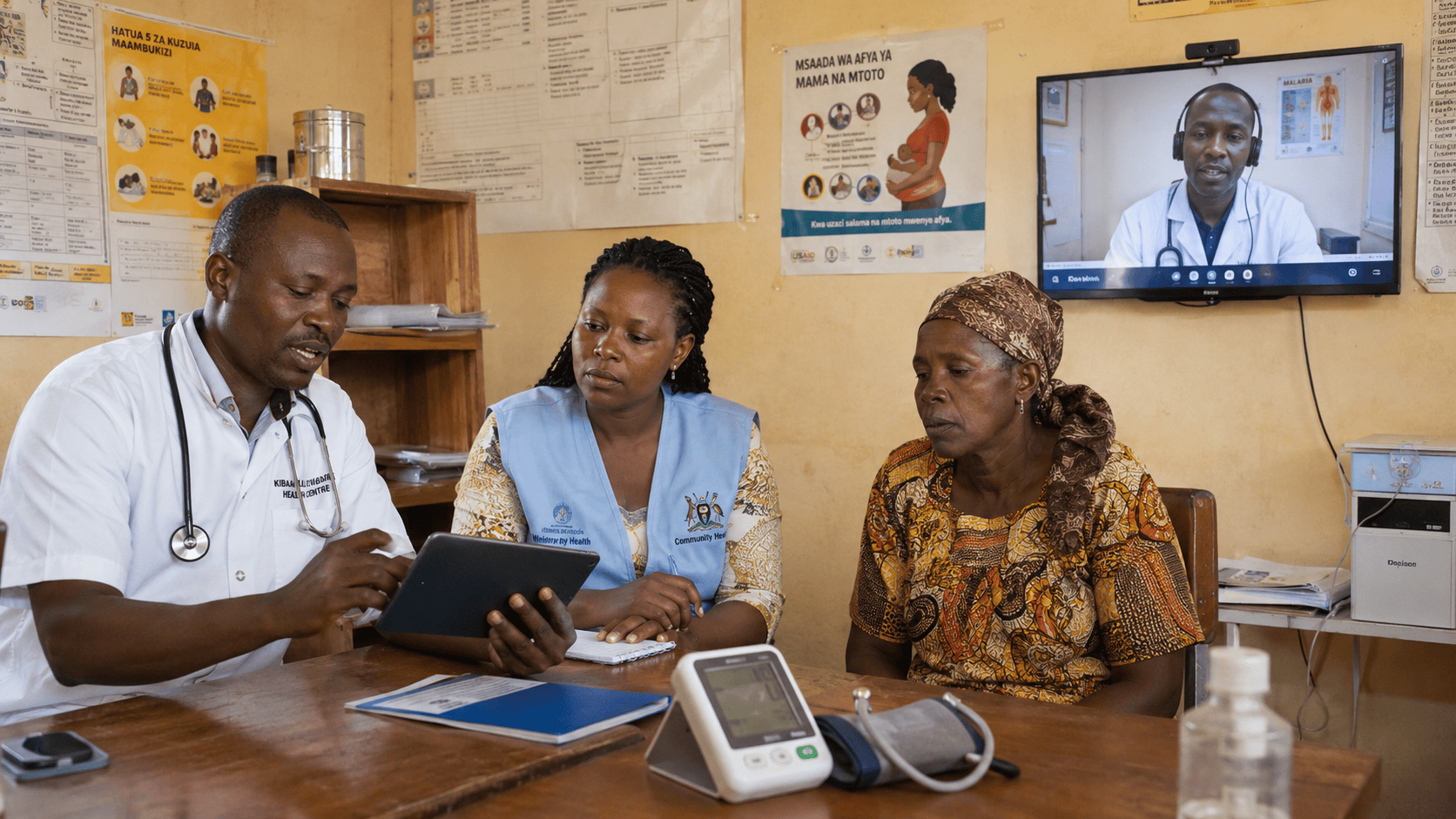
Technology transforming healthcare in Africa is no longer limited to video calls between doctors and patients. Digital tools are beginning to influence almost every stage of care, from finding a clinic and diagnosing an illness to delivering medicine, maintaining patient records and monitoring recovery at home.
This transformation is taking place because Africa’s healthcare systems face a difficult combination of pressures. Millions of people live far from specialist services, health facilities frequently lack equipment, patient information is often fragmented across paper files, and many families pay directly for care. At the same time, the WHO now projects that the African region could face a shortage of approximately 5.85 million health workers by 2030.
Technology cannot replace the doctors, nurses, pharmacists and community health workers the continent needs. It can, however, help each professional reach more patients, access better information, reduce administrative work and make decisions faster.
That is the real promise of African HealthTech: not replacing the health system with an application, but strengthening the system with connected tools.
Healthcare is becoming a connected patient journey
A conventional patient journey is often fragmented. A person may travel to a clinic, repeat their medical history, visit a separate laboratory, carry handwritten results to another facility and then search several pharmacies for prescribed medicine. Digital healthcare connects those steps.
A patient can begin with an SMS service or mobile application, consult remotely, visit a nearby clinic for digitally assisted testing, receive an electronic prescription and have medicine delivered. Their record can remain available for follow-up, while reminders, wearable devices or remote-monitoring tools help clinicians observe what happens after the patient leaves the facility.
The World Bank describes this broader transition as digital-in-health. Instead of treating technology as a separate pilot project, governments and providers integrate data and digital tools into clinical services, administration, financing and communication.
WHO member states reinforced that direction in 2025 by extending the Global Strategy on Digital Health to 2027 and beginning work on a successor strategy for 2028–2033.
AI is moving from experimentation into clinical support
Artificial intelligence can examine medical images, identify patterns in patient records, support clinical documentation, predict disease risks and help public-health teams allocate resources.
Its most realistic African use is not an autonomous machine replacing a doctor. It is a decision-support system that helps an overstretched clinician notice something they could otherwise miss.
A 2025 real-world study involving Penda Health in Kenya evaluated an AI clinical-support tool across 39,849 patient visits at 15 clinics. The researchers reported 16% fewer diagnostic errors and 13% fewer treatment errors among clinicians using the system. The tool was designed as a safety net within the existing workflow, while the clinician retained control over the final decision.
Jacaranda Health applies AI differently. Its PROMPTS platform provides pregnant and postpartum women with personalised information through two-way mobile messaging. It can identify questions and warning signs, provide guidance and escalate urgent concerns. Jacaranda says PROMPTS has reached approximately 3.8 million mothers in Kenya and is expanding to Nigeria through a partnership with eHealth Africa.
At government level, Rwanda’s Ministry of Health launched a Health Intelligence Centre in 2025. The centre brings health data together to support decisions concerning maternal deaths, HIV prevention, tuberculosis screening and outbreak surveillance.
These examples demonstrate that AI’s value depends on context. A technically impressive model has limited value when it is not integrated into clinical workflows, trained on relevant data or supervised by qualified professionals.
Telemedicine and mobile health extend the clinic
Telemedicine is particularly valuable where distance, transport cost and workforce shortages make physical consultations difficult.
Uganda’s Rocket Health combines remote medical consultations with laboratory services, pharmacy support and last-mile delivery. Instead of offering video calls as a standalone service, it connects the consultation to the practical services a patient may need afterwards. The company reported that demand for its platform rose sharply during the COVID-19 lockdown, illustrating how remote care can maintain access when physical movement is restricted.
Reliance Health operates a similarly integrated model across Nigeria and Egypt. It combines digital health insurance, telemedicine, partner hospitals and company-owned healthcare facilities. The company reports serving more than 200,000 people through over 4,000 businesses.
Mobile health does not always require a smartphone application. SMS, USSD, WhatsApp and voice services can be more accessible in communities where data is expensive, internet coverage is inconsistent or users are unfamiliar with complex interfaces.
That makes apparently simple tools, such as appointment reminders, medication messages and maternal-health information, potentially more scalable than sophisticated applications designed only for premium smartphones.
Electronic records are becoming healthcare infrastructure
Electronic health records, or EHRs, give authorised clinicians access to organised patient histories, diagnoses, prescriptions, laboratory results and treatment plans.
Their value is continuity. A doctor does not have to depend entirely on the patient’s memory or a paper folder that can be damaged, lost or left at another hospital. Digital records can also support billing, inventory, insurance claims and health-system planning.
WHO describes EHRs as a foundation for continuity of care, population-health management, clinical decision support and advanced analytics.
Nigeria’s Helium Health has developed one of Africa’s most visible commercial healthcare platforms around this need. HeliumOS supports medical records and hospital operations, while the broader ecosystem includes telehealth, billing, healthcare financing and AI-supported analytics. The company reports serving more than 500 providers, 10,000 health workers and one million patients.
Its model also demonstrates how digitisation can unlock financing. When a clinic has structured operational and revenue information, a lender can assess it more effectively. Helium Health says it has issued more than 500 healthcare loans and disbursed over $10 million through its financing operations.
Governments are also building national systems. Kenya operates platforms such as the Kenya Health Information System and the electronic Community Health Information System. In 2025, it launched biometric health identification as part of a broader digital-health programme.
Ethiopia’s Ministry of Health lists a growing portfolio that includes DHIS2, electronic medical records, an electronic community health-information system, digital pharmaceutical tracking and human-resource information systems. Its Digital Health Blueprint prioritises point-of-care data exchange, digital payments and interoperable systems.
The challenge is preventing each hospital, donor project or startup from creating another isolated database. Records become truly valuable only when systems can exchange information securely and use common standards.
Digital diagnostics bring equipment closer to patients
Many community clinics do not lack qualified personnel alone; they also lack laboratory analysers, imaging equipment and reliable supply systems.
Kenya’s Ilara Health addresses this problem by combining diagnostic equipment with financing, medicines and clinic-management software. Rather than requiring a small clinic to pay the full cost of an ultrasound machine or blood analyser upfront, the company helps facilities acquire and use equipment through longer-term commercial relationships.
The model matters because it treats primary-care facilities as businesses that need equipment, inventory, software and capital together. Supplying one machine without maintenance, training or financing may leave the clinic with technology it cannot use sustainably.
Portable and connected diagnostics can also enable screening outside major hospitals. Smartphone-connected devices, point-of-care tests and digitally transmitted images allow local health workers to collect information that specialists can interpret remotely.
Over time, AI may help prioritise abnormal scans and laboratory results, but local validation is essential. A system trained mainly on patients from Europe or North America may not perform equally well across African populations, equipment types or disease patterns.
Digital pharmacies are changing medicine access
Medicine availability is one of the most visible weaknesses in many health systems. Patients may visit several pharmacies before finding a prescribed drug, while providers struggle with stock management, counterfeit products and unpredictable prices.
Ghana-founded mPharma has built a health platform around community pharmacies and medicine supply. Its Bloom software supports inventory and pharmacy operations, while its Mutti network connects patients to primary care, telemedicine and chronic-disease services. British International Investment reports that the company serves almost 1.5 million patients annually across four countries.
The model attempts to reduce medicine stock-outs and spread purchasing power across a larger pharmacy network. Ghana Infrastructure Investment Fund reported in 2025 that 72% of surveyed patients within the Mutti network experienced lower prices and 96% reported fewer stock-outs, according to mPharma’s data.
Kenya’s MYDAWA connects online pharmacy ordering, licensed pharmaceutical support, telehealth and delivery. An investment announced in 2025 is supporting the opening of 30 pharmacies in Uganda and ten in Kenya, alongside further development of its digital platform. The company aims to reach 8.4 million patients annually by 2032.
Digital pharmacy can improve convenience and privacy, particularly for chronic conditions, reproductive health and other sensitive needs. It also creates regulatory responsibilities. Platforms must verify prescriptions, protect patient information, control the medicine supply chain and prevent the sale of inappropriate or falsified products.
Drones solve a physical infrastructure problem
Digital health still depends on moving physical goods. Blood, vaccines, laboratory samples and emergency medicine cannot be transmitted through a mobile application. In remote locations, poor roads and long travel times can turn an available medical product into an inaccessible one.
Zipline began medical drone deliveries in Rwanda in 2016 and later expanded its health-logistics operations to Ghana and other markets. Its aircraft transport lightweight medical supplies directly to health facilities, avoiding difficult road journeys. Zipline’s current global figures report almost two million deliveries and more than 60,000 estimated lives saved across its operations.
UNICEF identifies drones as a tool for extending health supply chains to remote areas and transporting vaccines, emergency products, samples and blood components. It also warns that successful deployment requires aviation regulation, safe operating procedures, sustainable costs and integration with the existing health supply chain.
The lesson is that drones are not valuable because they are visually impressive. They are valuable when they solve a measurable delivery problem more reliably or quickly than road transport.
Wearables and remote monitoring can keep patients connected
Wearable devices and remote-monitoring systems collect information such as heart rate, blood pressure, blood glucose, oxygen level or physical activity outside the hospital.
For patients managing diabetes, hypertension and heart disease, regular monitoring can reveal deterioration before it becomes an emergency. Data can be shared with clinicians or used to trigger reminders and follow-up calls.
In African markets, the most scalable systems may combine inexpensive devices with SMS, call centres and community health workers rather than depending entirely on expensive consumer smartwatches.
Remote monitoring also has to be clinically meaningful. Collecting large amounts of data without defining who reviews it, when an alert becomes urgent and how the patient receives care can create noise rather than better outcomes.
Robotics and blockchain have narrower but emerging roles
Robotic-assisted surgery is already available in parts of South Africa’s private healthcare system. Netcare hospitals use robotic systems for selected procedures, including cancer, urological and joint-replacement surgery. These systems remain controlled by trained surgeons and are concentrated in specialist facilities because of their cost and infrastructure requirements.
Robotics may gradually expand through better equipment utilisation and regional specialist centres, but it is unlikely to address basic primary-care shortages at the same scale as mobile health, diagnostics or digital records.
Blockchain is also discussed as a way to secure health-data exchange, verify records and improve traceability. WHO includes blockchain among technologies relevant to digital-health governance, but adoption remains mostly experimental.
A blockchain does not automatically make inaccurate data correct or guarantee privacy. Most healthcare systems first need reliable patient identification, interoperable records, clear consent rules and functioning cybersecurity controls.
54gene and the limits of innovation without durable institutions
Nigeria’s 54gene attempted to address the severe underrepresentation of African genomic data in global medical research.
The company raised significant investment, including a $15 million Series A in 2020, and built research and laboratory capacity around African genomics.
However, it began winding down in 2023 following financial difficulties, management changes and internal conflict.
Its closure does not reduce the importance of African genomic research. It demonstrates that scientifically valuable missions still require strong governance, sustainable revenue, disciplined spending, trusted research partnerships and careful stewardship of sensitive biological data.
HealthTech companies handle information and services that can affect lives. Growth cannot be separated from institutional credibility.
The main barriers to HealthTech adoption
The first barrier is infrastructure. Internet connectivity, electricity and device availability remain uneven. A platform designed only for uninterrupted broadband may fail in the communities that need it most.
The second is fragmentation. Hospitals, laboratories, insurers and government programmes often use systems that cannot communicate.
The third is regulation. HealthTech sits at the intersection of medicine, data protection, insurance, pharmacy, telecommunications and sometimes aviation. Companies may need approval from several authorities before operating.
The fourth is trust. Patients need confidence that telemedicine providers are qualified, medicines are genuine and sensitive information will not be misused.
The fifth is financing. Health startups often have longer sales cycles than consumer technology companies. Hospitals and governments may take months to procure a product, while hardware and clinical validation require substantial capital.
The sixth is evidence. A pilot that attracts users is not necessarily improving health outcomes. Companies must increasingly demonstrate clinical safety, affordability, reliability and cost-effectiveness.
WHO emphasises that sustainable digital health requires governance, investment, infrastructure, interoperability, legislation and workforce development.
What the next decade will look like
The future of HealthTech in Africa will be less about standalone applications and more about connected infrastructure.
AI will increasingly support clinicians, analyse records and improve public-health planning. Electronic records will become more portable. Digital pharmacies will connect medicine delivery with consultations and insurance. Remote monitoring will support chronic care. Drones and other autonomous systems will strengthen supply chains.
Cloud platforms will allow smaller facilities to access software without maintaining expensive local servers, while data analytics will help governments identify disease patterns and allocate staff and medicines.
The most successful companies will combine technology with care delivery, financing, logistics or public infrastructure. Rocket Health connects consultations with tests and delivery. Ilara connects diagnostics with financing. Helium Health combines records with payments and credit. Reliance combines insurance with digital and physical care.
Governments will also become more important customers and partners. Health systems cannot be transformed by private applications that sit outside national standards.
The central test will be inclusion. A digital service that works only for wealthy urban smartphone users may be profitable, but it will not solve Africa’s largest healthcare gaps.
Technology will create the greatest value when it helps a rural nurse access specialist advice, enables a pregnant woman to recognise danger signs, gives a clinic affordable diagnostic equipment, prevents a medicine stock-out or ensures that a patient’s history follows them to the next facility.
That is how digital innovation becomes more than HealthTech. It becomes healthcare.
Don’t miss important articles during the week. Subscribe to Techbuild weekly digest for updates