


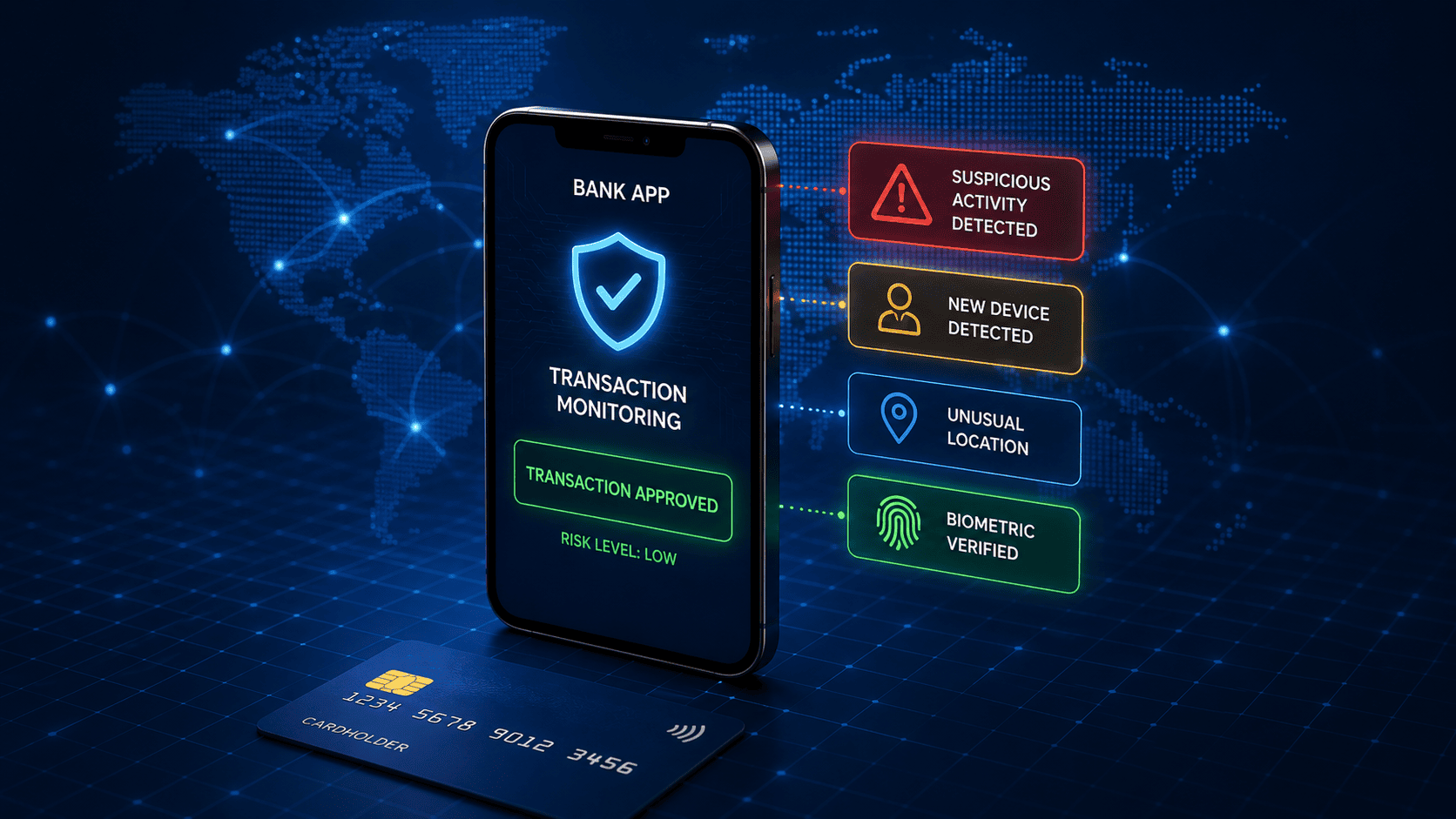
Digital fraud detection in banking has become one of the most important systems supporting the cashless economy. Every card payment, mobile transfer, agency-banking withdrawal or online purchase creates a brief window in which a bank must decide whether the person making the transaction is genuine, mistaken or criminal.
That decision may need to happen in less than a second. If the bank approves a fraudulent transfer, the money can move through several accounts and become difficult to recover. If it blocks too many legitimate transactions, customers lose trust and may abandon the service. Modern fraud detection is therefore not built around stopping everything unusual. It is designed to measure risk quickly, challenge the right transactions and allow normal customers to continue banking with as little friction as possible.
The challenge is growing as banking becomes faster. Instant payments, mobile money, digital wallets and agency banking have brought financial services closer to millions of people, but they have also expanded the number of accounts, devices, agents and payment channels that criminals can target.
INTERPOL reported in 2025 that cyber-related offences represented a medium-to-high share of all crime in two-thirds of the African countries it surveyed. In parts of Western and Eastern Africa, cybercrime accounted for more than 30% of reported crime. Online scams and phishing were the most frequently reported threats, alongside business email compromise and ransomware.
How a transaction is checked in real time
When a customer presses “send” or taps a card, the bank’s fraud-detection engine begins collecting signals. These may include the payment amount, merchant, account history, location, time, device, network address, recent login activity and how quickly the customer has attempted other transactions.
The system compares the new event with the customer’s normal behaviour and with known fraud patterns across the wider payment network.
A person who normally spends small amounts in Lagos during the day may suddenly attempt a large transfer from a new device in another country at 2:00 a.m. None of those details proves fraud on its own. Together, however, they may create a high-risk pattern.
The transaction is then assigned a risk score. A low score may lead to immediate approval. A medium score may trigger an additional check, such as a one-time password, biometric confirmation or in-app approval. A high score may cause the transaction to be paused, declined or sent to a fraud analyst.
Visa describes this as adaptive risk scoring. Its systems use machine learning to evaluate transactions in milliseconds and assign risk scores from low to high. The technology combines supervised and unsupervised learning, behavioural analytics, device fingerprinting and step-up authentication. The objective is not simply to detect more fraud, but to avoid incorrectly blocking legitimate customers.
The technologies behind the decision
Traditional fraud systems relied heavily on fixed rules. A bank could block any transaction above a certain value or any card used in two distant locations within a short period.
Rules remain useful because they are easy to understand and can respond quickly to known threats. But criminals study predictable controls and adjust their behaviour. They may break a large fraudulent transaction into several smaller payments or gradually change an account’s behaviour to avoid triggering a fixed limit.
Machine learning makes the system more flexible.
Supervised models learn from transactions that have already been labelled as genuine or fraudulent. They look for combinations of characteristics that frequently appear in confirmed fraud.
Unsupervised models search for unusual behaviour without requiring an exact previous example. This allows banks to detect emerging attacks that may not match known fraud cases. Semi-supervised models can combine both approaches, using confirmed examples while also searching for unexplained anomalies.
Artificial intelligence is particularly valuable because banks and payment companies process more transactions than human analysts could ever review manually.
Mastercard says its Decision Intelligence platform helps banks score approximately 143 billion transactions annually. Its generative-AI-enhanced Decision Intelligence Pro examines the relationships between accounts, merchants, purchases and devices. The system can scan up to one trillion data points and improve a transaction’s risk score in less than 50 milliseconds.
Mastercard’s initial modelling found that the enhancement could increase fraud-detection rates by an average of 20%, with significantly larger improvements in some cases.
Visa’s systems similarly analyse hundreds of attributes surrounding each transaction. The network view is important. An individual bank mainly sees activity involving its own customers, while a payment network can identify patterns across many banks, merchants, cards and locations.
A card-testing campaign that looks like a few insignificant payments at one bank may become obvious when the same devices, merchants or network addresses appear across thousands of transactions.
Read also: How Explainable AI Can Build Trust in Africa’s Digital Banking and Credit Systems
Behavioural analytics: identifying how a customer acts
Behavioural analytics looks beyond what a customer does to examine how the customer does it.
A banking application can learn a user’s usual typing speed, touchscreen pressure, swipe patterns, navigation habits and the typical sequence of actions completed before a transfer.
A fraudster who has stolen the correct username, password and PIN may still interact with the banking application differently from the real account owner. The fraudster may move rapidly between screens, paste information instead of typing it, access unfamiliar features or make a transfer immediately after logging in.
Behavioural information is combined with transaction and device data. It is not usually treated as proof of fraud on its own. Instead, it contributes to the overall risk score.
Biometrics and multi-factor authentication
Biometrics adds another identity layer. Fingerprints, facial recognition and voice checks can help confirm that the user possesses a physical characteristic linked to the account.
Biometrics is strongest when combined with something the customer possesses, such as a registered phone, and something the customer knows, such as a PIN. This layered approach is known as multi-factor authentication.
Nigeria’s Bank Verification Number system provides customers with a unique identity that can be verified across the banking sector. The Central Bank of Nigeria says the BVN helps reduce identity theft, identify blacklisted customers and protect accounts from unauthorised access.
Biometrics does not make fraud impossible. Criminals can use stolen identity documents, manipulated photographs, deepfakes or social engineering to defeat poorly designed verification systems. Banks must therefore use liveness detection, document validation and other contextual signals alongside facial or fingerprint checks.
Device fingerprinting and geolocation
Device fingerprinting creates a profile from the phone, computer or terminal being used for a transaction.
The profile may include the operating system, browser version, screen configuration, IP address, language settings, installed-app indicators and device identifiers.
Even when criminals hide one signal, the complete device profile may reveal that the transaction comes from an emulator, rooted phone, automated bot or device already connected to suspicious accounts. IBM’s fraud-prevention systems, for example, combine device identity, reputation databases, user behaviour and transaction patterns to detect account takeovers and unauthorised activity in real time.
Geolocation provides another layer of context. Banks can compare a payment terminal’s registered location with where it is actually being used or identify “impossible travel,” where the same customer appears in distant locations within minutes.
The Central Bank of Nigeria directed licensed payment operators to geo-tag Point-of-Sale terminals with their precise coordinates. The measure is intended to strengthen oversight of terminals used by agents and merchants and make suspicious terminal activity easier to trace.
The most common forms of digital banking fraud
Account takeover begins when criminals obtain a customer’s password, PIN, card details or one-time security code. Phishing emails, fake banking websites, fraudulent customer-service calls and deceptive SMS messages are common entry points.
SIM-swap fraud occurs when a criminal gains control of a victim’s mobile number. Once the number is transferred to another SIM card, the criminal may receive transaction alerts and authentication codes intended for the customer.
Authorised push-payment scams are more difficult to detect because the real customer approves the transfer. The victim may believe they are paying an investment company, relative, online seller, romantic partner or government official.
From the bank’s perspective, the correct customer logged in and authorised the transaction. Detection therefore depends on recognising suspicious beneficiaries, unusual payment behaviour, scam-linked accounts and the rapid movement of money after it reaches the recipient.
Card-not-present fraud occurs when stolen card information is used online without the physical card. Criminals may first test the card with several small payments before attempting a larger purchase.
Chargeback or “friendly” fraud happens when a customer makes a genuine purchase and later falsely claims that the transaction was unauthorised or that the product was never delivered.
Synthetic-identity fraud combines real and invented information to create a person who does not exist. Fraudsters may use the synthetic identity to open accounts, obtain loans and gradually build a credible financial history before disappearing with larger sums.
Business email compromise targets organisations by impersonating executives, employees or suppliers and sending false payment instructions. Insider fraud involves employees or contractors abusing legitimate system access.
Paystack identifies synthetic identities, phishing, insider threats and chargeback fraud among the risks confronting online businesses and payment providers.
The African fraud landscape
Africa’s rapid adoption of mobile money, instant transfers and agency banking has created enormous economic value. It has also produced a wider surface for fraud.
Agency banking depends on large networks of small businesses and independent agents. This brings banking closer to communities but introduces risks involving fake agents, compromised terminals, manipulated receipts, identity theft, unauthorised cash withdrawals and account takeovers.
Mobile-money customers may be targeted through SIM swaps, deceptive messages, false reversals and criminals posing as customer-service representatives. GSMA guidance identifies identity theft, SIM-swap attacks and SMS fraud as major mobile-money risks.
Nigeria illustrates both the scale of digital payments and the investment being made in fraud prevention. NIBSS reported that digital-payment fraud losses declined to ₦25.85 billion in 2025, compared with ₦52.26 billion in 2024. The previous year’s figure was heavily affected by one exceptionally large incident involving a single organisation.
The reduction does not mean that the threat has disappeared. As payment volumes rise, institutions must protect more transactions across mobile applications, cards, PoS terminals, USSD services and instant-transfer networks.
What happens after a fraud alert?
A high-risk alert does not automatically mean that a crime has occurred. The first response is often automated containment.
The institution may decline the payment, delay settlement, reduce transaction limits, block the device or require stronger authentication.
The alert then enters a case-management system. A fraud analyst examines the transaction, account history, device links, beneficiary relationships and any similar alerts.
Graph analytics may show that the receiving account is connected to many recently opened accounts or that money is being rapidly divided and transferred through a network of mule accounts.
The bank may contact the customer through a trusted channel. When the customer denies making the transaction, the institution can freeze the account, block compromised credentials and attempt to recall the funds from the receiving institution.
The bank must also preserve logs, device records, communications and other evidence that may be needed for internal investigation or law-enforcement action.
Confirmed cases may be reported to financial-intelligence units, regulators and law-enforcement agencies. The case result is fed back into the fraud system so similar future transactions can be scored more accurately.
Speed is critical. In January 2026, the Central Bank of Nigeria announced a target requiring banks to reduce their fraud-response time to less than 30 minutes.
The CBN has also introduced requirements for real-time enterprise fraud monitoring, stronger identity verification and temporary limits when mobile-banking applications are activated on new devices. Under rules taking effect in July 2026, a banking application may be linked to only one device at a time, while a newly activated device will initially operate under a temporary transaction limit.
How major payment companies approach fraud
Mastercard
Mastercard’s approach centres on network intelligence and AI decision-making.
Decision Intelligence Pro evaluates relationships among the different entities surrounding a transaction instead of treating each payment as an isolated event. It considers the account, merchant, device, location and previous transaction patterns before improving the risk score supplied to the customer’s bank.
This helps banks approve legitimate transactions while identifying connected fraud attempts that may be invisible when each payment is examined separately.
Visa
Visa uses real-time risk scoring, behavioural history and deep-learning systems across card and account-to-account payments.
Its approach illustrates the central tension in fraud prevention: eliminating all possible fraud would require rejecting many genuine transactions. The better strategy is to approve low-risk payments seamlessly while adding authentication or intervention only when the transaction’s risk justifies it.
JPMorgan Chase
JPMorgan Chase combines fraud-detection technology with customer controls, monitoring and public education.
In its 2024 shareholder letter, the bank said investments in scam and fraud detection had prevented Chase customers from losing an estimated $12 billion.
The bank also stressed that financial institutions cannot solve the problem alone because many scams begin on social-media, telecommunications or retail platforms before a payment request reaches the bank.
Interswitch
In Africa, Interswitch offers enterprise fraud monitoring across cards, ATMs, PoS terminals, mobile applications and online-banking channels.
Its Proactive Risk Manager combines predefined rules, machine-learning scores, behavioural profiles and network intelligence. It is designed to identify cross-channel threats such as account takeovers, suspicious transaction velocity and mule-account networks.
Paystack
Paystack uses an in-house Risk Assessment Management System, known as RAMS, to monitor transactions in real time.
RAMS applies rules tailored to the payment method, merchant profile and normal industry behaviour. It tracks fraud value and fraud ratios and flags merchants that exceed defined thresholds for further investigation.
Paystack’s merchant controls also include IP whitelisting, two-factor authentication, biometric passkeys, role-based permissions and transfer approvals. Its remediation process includes merchant notification, investigation, corrective action and continued monitoring.
Flutterwave
Flutterwave has emphasised that AI and machine learning can strengthen real-time fraud detection, but that the technologies are not a complete solution on their own.
Effective fraud control still requires strong internal processes, good data, trained fraud teams, customer education and collaboration across the financial ecosystem.
Moniepoint
Moniepoint’s public technical and recruitment materials show a focus on developing machine-learning models for fraud detection and continuously monitoring and retraining those models.
Its policies also provide for analysing transaction patterns, identifying anomalies and monitoring account inflows and outflows so that suspicious transactions can be flagged or restricted.
Access Bank and GTBank
Access Bank and GTBank combine internal security systems with customer education.
Access Bank says it uses customer information to detect and prevent fraud, money laundering and other financial crimes. It also publishes phishing warnings and provides dedicated channels through which customers can report suspicious activity.
GTBank states that biometric information may be collected for identity verification, security and fraud prevention. The bank also provides additional card-security controls and public guidance for identifying fake websites, messages and fraudulent communications.
These customer-facing measures are important because many successful attacks begin by manipulating people rather than directly breaking into a bank’s technology.
Security without making banking unbearable
A fraud system that blocks every unusual activity is not an effective system. A legitimate customer may purchase an expensive laptop, travel abroad, change phones or transfer money at an unfamiliar time. Each activity may look unusual while still being genuine.
Banks therefore use step-up security. Familiar, low-risk activity moves quickly. A transaction with some warning signs may require fingerprint approval, an additional in-app question or confirmation from a registered device. Only the highest-risk activity is stopped or sent for manual review.
Banks also monitor false positives: genuine transactions incorrectly classified as fraudulent. Too many false positives reduce card acceptance, interrupt businesses, inconvenience travellers and overwhelm fraud-investigation teams. Better models use broader context to distinguish a genuine change in a customer’s life from a criminal takeover.
The future: collaborative and predictive defence
The next generation of fraud detection will rely more heavily on graph AI, shared intelligence and privacy-preserving collaboration.
Graph systems can uncover relationships between devices, accounts, agents, merchants and beneficiaries that appear unrelated in a conventional database. Instead of seeing ten isolated accounts, the bank may discover that the accounts share one phone, IP address, agent or beneficiary.
Generative AI will help analysts summarise investigations, search large volumes of alerts and identify patterns hidden in unstructured reports.
Criminals will use the same technology to produce more convincing phishing messages, cloned voices, fake documents and deepfake identity checks. This will create an ongoing competition between AI-powered attack and AI-powered defence.
Financial institutions will also need to share confirmed fraud indicators more quickly through regulated industry platforms. Privacy-preserving technologies, including federated learning, could allow multiple institutions to improve shared fraud models without exchanging complete customer records.
The strongest defence will remain layered. Identity controls reduce fraudulent account openings. Device intelligence detects compromised access. Behavioural models recognise abnormal actions. Transaction scoring decides when to intervene. Human analysts investigate complex cases. Regulators and law-enforcement agencies pursue the criminal networks behind the payments.
What customers can do to reduce their risk
Customers should never disclose passwords, PINs or one-time security codes to callers or people claiming to represent a bank. A genuine bank employee should not need a customer’s complete password or transaction PIN.
Banking applications and websites should be opened directly rather than through unsolicited links. Customers should enable transaction alerts, use limits that reflect their normal needs and report suspicious debits immediately through official bank channels.
Passkeys, biometrics and multi-factor authentication make stolen passwords less useful. Customers should also confirm account names and unusual payment requests independently, particularly when someone creates urgency, requests secrecy or claims that an immediate transfer is required to protect an account.
A bank can identify abnormal data, but it cannot always know that a genuine customer is being emotionally manipulated into authorising a scam.
The cashless economy depends on trust
Digital banking fraud will not disappear because every successful security improvement encourages criminals to change their tactics.
But modern fraud detection has made financial crime faster to identify, harder to scale and easier to investigate.
The real achievement is largely invisible. It is the legitimate transfer completed without interruption because hundreds of risk signals agreed that the customer was genuine. It is the suspicious payment challenged before the money left the account. And it is the alert that connected one small transaction to a much larger criminal network.
As Africa’s digital-payment economy grows, banks and fintech companies will need to protect speed without sacrificing safety.
The institutions that succeed will be those that treat fraud prevention not as a single security product, but as a continuous system built around technology, human judgement, regulation, industry cooperation and customer trust.
Don’t miss important articles during the week. Subscribe to Techbuild weekly digest for updates