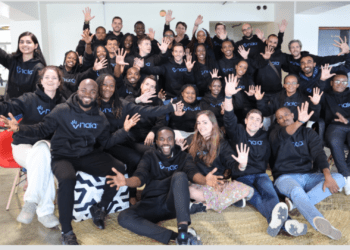
Eyone Medical, a Dakar-based healthtech firm, has landed approximately $3 million (1.7 billion CFA francs) in funding from Oyass Capital, a newly launched SME-focused private equity fund backed by the Senegalese government.
The announcement was made during the fund’s official launch at Dakar’s King Fahd Palace Hotel, where government officials, entrepreneurs, and fund managers gathered to mark the debut of Oyass Capital’s first disbursements.
The funding comes as part of a $4.4 million (2.7 billion CFA francs) tranche allocated to two Senegalese companies, Eyone Medical and agri-food SME Dimbaya, which received the remaining $1.65 million (1 billion CFA francs).
These are the first portfolio companies of Oyass Capital, a 52 billion CFA franc ($89 million) vehicle sponsored by FONSIS, Senegal’s Sovereign Strategic Investment Fund. The fund is designed to address the chronic funding gap that hinders the scale-up of domestic SMEs.
Speaking at the event, Oyass Capital President Jamal Abisourour stated that the fund is looking to back companies that are positioned to contribute meaningfully to Senegal’s broader economic goals. “Eyone and Dimbaya represent the kind of firms that can help build more self-sustaining and integrated value chains,” he said.
Founded in 2015 by Henri Ousmane Gueye and John Diatta, Eyone Medical specializes in interoperable digital health solutions, most notably its flagship product Dossier Patient Unique Partagé (Shared Patient Record).
The platform enables clinics and hospitals to centralize, manage, and share patient records securely across different health institutions.
The company already works with more than 60 healthcare institutions across Senegal, Mali, Côte d’Ivoire, Cameroon, Gabon, and France. Notably, Senegalese telecom giant Sonatel led a $1 million round in Eyone in 2024 via its Venture Innovation Fund, alongside participation from local bank BICIS, affiliated with BNP Paribas.
The recent investment from Oyass will help Eyone enhance its infrastructure, integrate AI into its digital health systems, and grow its footprint across Francophone West Africa.
Gueye emphasized that disorganized health records and redundant testing remain significant obstacles in the region’s healthcare systems. “We built Eyone to simplify access to accurate patient information, so care providers can make informed decisions quickly, and patients aren’t penalized by inefficiencies,” he said.
Beyond Eyone’s growth, the deal signals a wider shift in how governments across Francophone Africa are approaching entrepreneurship.
Once confined largely to policy oversight, public institutions are now increasingly stepping into co-investor roles, deploying capital alongside development finance institutions and local investors to catalyze the growth of strategic sectors like healthtech and fintech.
This mirrors activity in markets like Côte d’Ivoire, where Djamo, a neobank focused on financial access, secured $1.3 million in public-backed funding earlier this year.
Such moves show a willingness to experiment with new financial models, especially for startups aiming to tackle large-scale inefficiencies in public services.
While early, Eyone’s latest raise underscores that local healthtech solutions, if well executed and locally integrated, are beginning to draw sustained support from both public and private sources.
If this funding is put to productive use, it could help shape more efficient healthcare delivery systems across West Africa, starting with better data.
This post first appeared here.
Don’t miss important articles during the week. Subscribe to techbuild weekly digest for updates