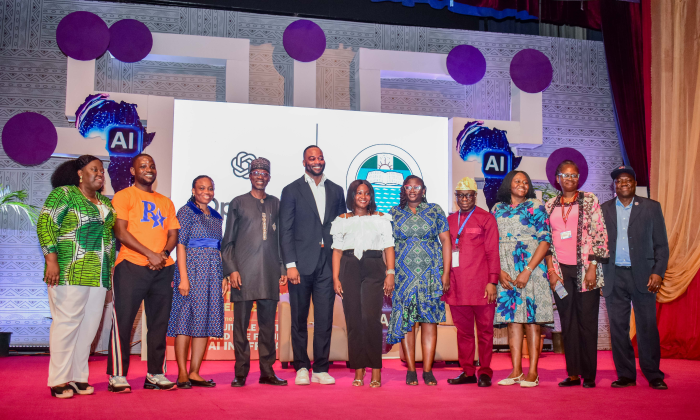
The University of Lagos, in collaboration with OpenAI, hosted Africa’s first OpenAI Academy on October 15–16, 2025, as part of the University’s 5th International Week themed “Equitable Partnerships and the Future of AI in Africa.”
Launched in 2024, the OpenAI Academy is a key part of the company’s education mission to make the benefits of AI available to everyone.
The program has already equipped millions of learners around the world, turning complex AI concepts into practical, responsible AI skills through free workshops, interactive sessions, and community-driven learning.
The Lagos event was OpenAI Academy’s debut in Africa, expanding its reach to a new generation of innovators and creators.
Undergraduate students from the University of Lagos participated in guided, hands-on sessions covering machine learning, generative AI, AI ethics, responsible innovation, and real-world applications of AI.

Day one of the programme featured a keynote address from Emmanuel Lubanzadio, OpenAI’s Africa Lead, highlighting how students can use AI tools to enhance learning, problem-solving, and creativity.
This initiative was led by the University’s Office of International Relations, Partnerships and Prospects (IRPP), in collaboration with the African Engineering and Technology Network (Afretec).
It aligns with the African Union’s Digital Transformation Strategy (2020–2030) and Nigeria’s National Digital Economy Policy, both of which prioritise inclusive skills development and responsible innovation.
Professor Ismail Ibraheem, Director of IRPP, said:
“At the University of Lagos, we are intentional about preparing our students to solve the unique needs of our continent through global partnerships. We prioritise inclusive access to digital skills, research, and learning opportunities to empower future innovators. Our goal is to help them approach AI with contextual understanding and ethical responsibility.”
Emmanuel Lubanzadio, OpenAI’s Africa Lead, said:
“Africa is home to some of the world’s most creative, resourceful problem-solvers. We want to make sure they have the tools to turn their ideas into impact. Launching the OpenAI Academy in Lagos is a major step toward supporting the next generation of African innovators, giving them practical skills, connecting them to a global community, and helping ensure that AI reflects African voices and priorities.”
Part of day two of the programme featured a fireside chat with Emmanuel Lubanzadio.

On the choice of the University of Lagos as the first point of call for the OpenAI Academy workshop in Nigeria, Emmanuel reiterated that it’s almost a general knowledge that Lagos is a tech magnet, not only on the continent, but also across the world.
“Many unicorns are in Africa, in Nigeria. So, by default, we are here in UniLag. But also, the power of the work you are doing. And I think Unilags does a phenomenal job at this. And for this reason, it was just by default that this engagement was like a match made in heaven.“, Emmanuel added
On how OpenAI is ensuring that Africans are not just consumers of AI tools, but also creators and innovators. Emmanuel believes it all starts with access. “We can have any conversations about ensuring that Africans are not only consumers, but also producers; however, we need to talk about access and access being what I’ve mentioned with ChatGPT Go”
Another aspect, according to Emmanuel, is capacity building. “What I mean by capacity building is you need to train the next generation. And it’s not only a company’s responsibility, but I think it’s a multi-stakeholder approach. You have academia’s responsibility, your responsibility, and also the government’s responsibility.”
From our part, it is for us to ensure that people are not only consumers, but also practitioners, by providing access and capacity building. And therefore, we created the Open AI Academy.
On OpenAI’s biggest challenge on the African continent, Emmanuel acknowledged that challenges of this nature are not unique to the continent.
“Certain developments are different from anywhere else in the world. But AI is new for everybody. I think everybody is trying to grapple with how to deal and manage AI, because ChatGPT launched literally three years ago.”
“And in 2025, you have more access, but other nations are also grappling with capacity building, and access oftentimes. So I wouldn’t say they are all unique challenges to Africa. I think there are more global challenges. This is the perspective I see, because again, I do believe Africa will shape its own AI journey and the future.
Institutions like UniLag are also there and seeking to ensure that the next generation is prepared. And therefore, this collaboration that we have now is quite important.”
Beyond the University of Lagos programme, Emmanuel reiterated that the vision for OpenAI is that its products or AI in general become accessible to all. Emmanuel likened this possibility to the availability of electricity.
“Our vision is really that more people have access to it. And as I said earlier, access or AI literacy is not one person’s or company’s responsibility. It has to be a multistakeholder approach.”
“For instance, on this collaboration with UniLag, we had a conversation, and we made it happen within a month. And I do believe that there are different synergies and mutual areas of interest where leaders are coming together. And this is the right way to go about it. When you ask how we ensure our part is done? We are providing democratizing access to education through the Open Academy, which is accessible for free.
It all comes down to being a multistakeholder approach, public-private partnerships between different sectors, and collaboration after all.”
On the unique way Africa has adopted AI, Emmanuel gave instances of how Digital Green partnered with OpenAI to deploy its GPT model in a chatbot to help farmers with knowledge about the crops. Another instance is the Jacaranda Health in Kenya.
According to Emmanuel, the platform created a health clinic for expectant mothers and also integrated AI into their respective systems in a way that pregnant mothers with questions can communicate with the system with supervision from their doctors.
“One thing I would like to stress here is that AI is so cross-sectoral that you cannot only point towards one, two, or three industries, because the technology is such a big one. Its impact is cross-sectoral. But one factor is key, it’s been used by several different sectors and people on the continent.”
In his final note to students, Emmanuel stressed that this is the best time to be a student. “The access to knowledge that we have, we should see this as an opportunity. This technology is freely available with one click, and you carry a technology in your pockets, which can be your research assistant, your content creator, and your advisor.”
For this reason, I would love for people to understand that AI can be a great equaliser, and it is a great opportunity.”
This first OpenAI Academy in Africa lays the foundation for deeper collaboration and a more connected AI learning landscape shaped by Africa’s priorities and strengths.
It also comes in the same week that OpenAI rolled out ChatGPT Go in Nigeria and 56 other countries. ChatGPT Go is a new subscription tier designed to give more people access to ChatGPT’s advanced capabilities at a more affordable price.
Featured Image: Emmanuel Lubanzadio, OpenAI’s Africa Lead (L); Folasade Ogunsola, Vice-chancellor of the University of Lagos at OpenAI Academy Workshop, University of Lagos.
Don’t miss important articles during the week. Subscribe to techbuild weekly digest for updates