

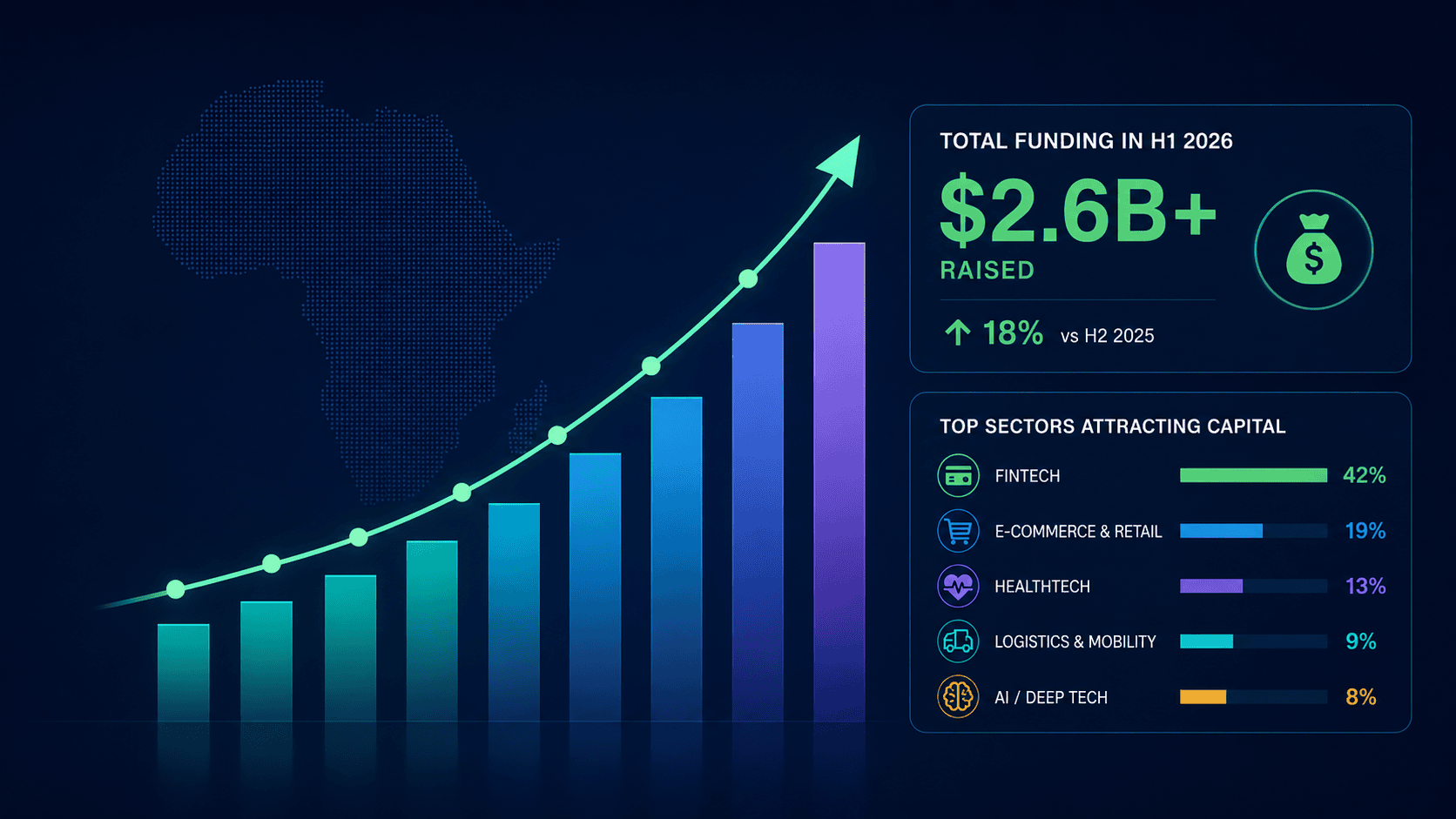
At first glance, the Africa H1 2026 Startup Funding Report tells a story of remarkable resilience. With total funding crossing the $1.4 billion mark, the continent appears to have stabilized after the venture winter of previous years. June 2026 alone saw a staggering half a billion dollars flow into the ecosystem, suggesting that the spigots of global capital are finally opening again.
However, a deeper dive into the data reveals a hall of mirrors effect. While the headline total held steady, almost every underlying metric shifted. We are no longer in an era of “growth at all costs” characterized by hundreds of seed-stage bets. Instead, H1 2026 was defined by extreme concentration, a pivot toward asset-heavy infrastructure, and a fundamental decoupling of transaction volume from venture inflows. For founders, investors, and policymakers, the real numbers suggest that while the ceiling remains high, the floor has become significantly harder to reach.
The Macro Funding Landscape: Stability as an Illusion
The most striking revelation of the Africa Startup Funding Report H1 2026 is the disconnect between capital volume and deal velocity. Startups raised between $1.4 billion and $1.5 billion during the first half of the year, a figure roughly level with H1 2025. Yet, this capital was distributed across only 146 disclosed deals, a sharp 42% decline from the 252 deals recorded in the same period last year.
This creates a barbell effect in the market. At one end, a tiny elite of late-stage companies is vacuuming up massive checks; at the other, early-stage activity is struggling to maintain momentum. Roughly half of all H1 funding went to just seven companies. The median deal size (the amount a typical founder actually raises) has nearly halved year-on-year.
What does this mean? For founders, it means the missing middle is real. Raising a $5–15 million Series A or B is now the most competitive segment of the market. For investors, it signals a flight to quality and scale. The market is no longer rewarding potential; it is rewarding established winners with proven unit economics or significant physical assets.
Regional Analysis: The Great Rebalancing
For the first time in recent history, the traditional “Big Four” hierarchy is being fundamentally questioned. While Nigeria, Kenya, Egypt, and South Africa still account for 53% of all deal activity, this is a notable drop from 64% just a year ago.
Kenya: The New Capital Magnet
Kenya has officially overtaken Nigeria in total capital raised, a trend that began in 2025 and solidified in H1 2026. The engine of the “Silicon Savannah” is no longer just fintech; it is clean-energy hardware. Giants like d.light, Sun King, and M-KOPA have turned Kenya into a global hub for solar-connected appliances, accounting for the lion’s share of the country’s nearly $1 billion in recent annual funding.
Nigeria: The Volume Paradox
Nigeria remains the most active market by deal count, but it is trailing badly on deal size. The average Nigerian round in recent periods sat at approximately $1.6 million, compared to Kenya’s $6.9 million. Nigeria’s story is now a tale of two scoreboards: it leads the continent in digital transaction volume but struggles with venture inflows due to a weak naira (averaging ₦1,420/$ in H1) and persistent inflation.
Egypt and South Africa: Consistency and Infrastructure
Egypt remains the primary destination for fintech capital, leading the continent in Q1 2026 with $190 million in disclosed funding. South Africa, meanwhile, is carving a niche in large-scale infrastructure plays, evidenced by Paymentology’s $175 million raise and SolarAfrica’s $94 million debt facility.
The Rise of Francophone and North Africa
The most exciting “under the radar” trend is the geographic spread beyond the Big Four. Côte d’Ivoire (GoCab), Morocco (Agenz), and emerging clusters in Senegal and Tunisia are capturing a growing share of investor interest, signaling that the continent’s tech future is becoming more decentralized.
Read also: Agenz Lands $5M to Digitize Morocco’s Housing Market
Sector Analysis: From “Software is Eating Africa” to “Hardware is Building It”
If 2021 was the year of the consumer app, 2026 is the year of asset-heavy infrastructure. The sectors winning the most capital are those that own ‘real things’ like solar panels, electric motorbikes, or massive lending books.
- Mobility & Climate-Tech: This sector was the undisputed heavyweight of H1. Spiro, the electric-mobility firm, raised roughly $327 million across four rounds representing between a fifth and a quarter of all continental funding.
- Fintech: While still dominant in deal count, fintech is maturing. The focus has shifted from simple payments to infrastructure (e.g., Paymentology) and embedded finance (e.g., Moniepoint’s certification as a direct switch).
- Clean Energy: Kenya’s dominance proves that solar and grid-edge technology are no longer niche impact investments; they are the bedrock of African consumer expansion.
Major Funding Rounds and What They Signal
The largest deals of H1 2026 were not classic equity-only growth rounds. They were complex, multi-instrument transactions that signal a high degree of investor sophistication:
- Spiro ($327M across 4 rounds): A mix of debt from Afreximbank and equity from Impact Fund Denmark. This signals that institutional lenders are now willing to back African hardware at scale.
- Paymentology ($175M): A massive infrastructure play for card-issuing, proving that B2B tools for banks remain a high-conviction bet.
- Flutterwave ($100M Series E): Reportedly tied to a strategic partnership with Ripple to integrate stablecoins (RLUSD). This signals that the “next phase” of fintech involves blockchain-enabled cross-border settlement.
- MNT-Halan ($50M): Led by the investment arm of the National Bank of Egypt. This highlights the growing role of domestic corporate venture capital (CVC) in North Africa.
Investor Behavior: The Age of Debt and Consolidation
Investor behavior in H1 2026 can be summarized in two words: De-risking and Efficiency.
- The Debt Revolution: Debt financing made up nearly 43% of all capital raised in H1. Founders are increasingly reluctant to give up equity at current valuations, while investors prefer the security of asset-backed loans. Companies like valU, Blnk, and SolarAfrica are leading this charge, treating debt as a primary growth strategy rather than a fallback.
- The M&A Wave: A record 63 M&A deals closed in H1 2026, nearly double the volume of H1 2025. ‘Merge’ has officially replaced ‘raise or shut down’ as the default move for mid-tier startups. The acquisition of Mono by Flutterwave is a prime example of market consolidation.
- AI as a Scalpel: Startups are no longer just talking about AI; they are using it to restructure. Jumia and Zap Africa both announced significant layoffs in H1, explicitly framing these moves as shifts toward AI-driven customer support and operations.
Behind the headlines of the Africa Startup Funding Report H1 2026 lie three uncomfortable truths:
- The “Spiro Dependence”: Without one company (Spiro), the continental funding total would look significantly worse—trailing the top three deals of 2025 combined. The ecosystem’s perceived health is currently tied to a very small number of outliers.
- The Tracker Discrepancy: The real number depends entirely on who you ask. Discrepancies between trackers like Africa: The Big Deal ($1.44B) and Launch Base Africa ($1.21B) stem from how they define startups versus infrastructure companies. This suggests that African tech is evolving into an asset class that no longer fits into traditional venture capital buckets.
- Nigeria’s Infrastructure vs. Inflows: Nigeria’s NIBSS processed ₦620 trillion in H1 2026. Moniepoint terminals handle 8 out of every 10 in-person payments in the country. Yet, this massive domestic volume hasn’t insulated Nigeria from a funding slowdown. The lesson here is that market dominance in local currency does not automatically solve the dollar-denominated fundraising challenge.
Five Predictions for H2 2026
Based on the trajectory of the Africa H1 2026 Startup Funding Report, here is what we expect for the remainder of the year:
- Debt Dominance: Asset-heavy sectors will continue to prioritize debt and securitization over equity, potentially pushing debt to over 50% of total capital by year-end.
- The “Great Consolidation”: Expect at least one ‘mega-merger’ between two household names in the fintech or e-commerce space as the M&A trend accelerates.
- Nigeria’s Regulatory Moat: The CBN’s August 2026 deadline for GPS-tagging POS terminals will likely force smaller players out, further cementing the dominance of incumbents like Moniepoint.
- The Rise of the “Secondary” Hubs: Côte d’Ivoire and Morocco will likely break into the top five for deal count by the end of H2, challenging South Africa’s position.
- AI-First Pitch Decks: Every Series A raise in H2 will likely require an explicit AI-efficiency plan, moving beyond generative AI hype to real operational cost-cutting.
Conclusion
The Africa H1 2026 Startup Funding Report shows a market that is maturing, albeit painfully. The days of easy equity are over, replaced by a sophisticated landscape of debt, M&A, and strategic consolidation. Nigeria remains the heart of the continent’s digital economy through sheer payments volume, even as Kenya and Egypt take the lead in capital attraction.
For the African tech ecosystem, the “real” numbers show that success in 2026 is no longer measured by the size of a seed round, but by the ability to build an asset a lender will back or a competitor will buy. Stability has returned, but it is a stability built on the foundations of infrastructure rather than the shifting sands of hype.